Keiko Fujimori Promises ‘Order and Reconciliation’ as Peru’s New President
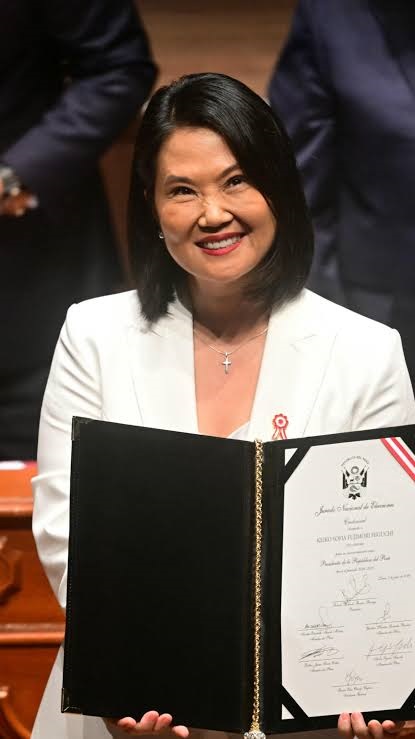
LIMA, Peru — Keiko Fujimori pledged to restore order while promoting national reconciliation as she began her five-year term as Peru’s president on July 28, setting out an ambitious security and economic agenda for one of Latin America’s most politically divided countries.
Fujimori, 51, was sworn in after narrowly defeating left-wing congressman Roberto Sánchez in the June presidential runoff. She is the first woman elected by popular vote to lead Peru and the latest president to inherit a country marked by repeated leadership changes, public distrust and growing concern over organized crime.
“I am committed to bringing about order and national reconciliation,” Fujimori said in her inaugural address, arguing that the two objectives were “entirely compatible.”
Her appeal for unity came alongside promises of a forceful crackdown on extortion, drug trafficking, illegal mining and other forms of organized crime. The combination reflects the central challenge facing the new administration: reassuring voters demanding tougher security while convincing opponents that her government will respect democratic institutions and civil liberties.
Fujimori places security at the center of her presidency
Fujimori announced that Peru’s armed forces would temporarily take the lead in security operations in areas placed under states of emergency. The military would work with the National Police to confront criminal organizations operating across the country.
She also intends to reorganize the prison system and has previously proposed constructing several new prisons, including a high-security complex inspired by El Salvador’s Terrorism Confinement Center. Her campaign additionally supported protecting the identities of judges handling dangerous organized-crime cases.
The security platform helped Fujimori appeal to voters alarmed by violent extortion rackets and criminal gangs. Crime was one of the dominant issues in the 2026 election, contributing to a broader conservative shift across several Latin American countries.
Fujimori described Peru as a country battered by insecurity, ineffective government and declining public confidence. She promised a more disciplined administration built around clear targets, reduced unnecessary spending and closer coordination between state institutions.
Reconciliation pledge faces immediate scepticism
Fujimori’s message of reconciliation is likely to face considerably more scrutiny than her security promises.
The election exposed stark geographical and political divisions. Fujimori received strong backing in Lima and along Peru’s Pacific coast, while Sánchez dominated many highland communities. Final results showed Fujimori with approximately 9.223 million votes, or 50.135%, compared with Sánchez’s 9.173 million, or 49.865%.
Sánchez challenged aspects of the count, although electoral authorities rejected his complaints. Some lawmakers from his political alliance walked out during Fujimori’s inaugural address, while demonstrators gathered in Lima to protest her assumption of power.
Opposition representatives carried photographs of people killed during past episodes of state violence, including victims from the government of Fujimori’s father and those who died during protests following the removal of former president Pedro Castillo in late 2022.
These scenes illustrated how difficult it may be for the president to persuade critics that her call for reconciliation represents more than an effort to neutralize political opposition.
Alberto Fujimori’s legacy continues to divide Peru
Keiko Fujimori’s presidency marks the return of Fujimorismo to executive power nearly three decades after the political movement was led by her father, Alberto Fujimori.
The former president governed Peru from 1990 to 2000. His supporters credit him with stabilizing the economy and defeating the Shining Path insurgency. His administration, however, became increasingly authoritarian, and he was later convicted over human rights abuses and corruption. Alberto Fujimori was pardoned in 2023 and died the following year.
Keiko Fujimori had previously lost presidential elections in 2011, 2016 and 2021. Her family name mobilized a loyal conservative base but also strengthened an antifujimorista movement that regarded her candidacy as a potential return to authoritarian government.
During her inauguration, Fujimori attempted to address those fears by promising to respect the constitutional length of her mandate and remain in power for five years—and “not a year more.”
Minimum wage increase and economic pledges
Alongside her security strategy, Fujimori announced a 15% increase in Peru’s minimum wage, raising it from 1,130 soles to 1,300 soles per month.
The president also promised to improve the investment climate, accelerate infrastructure projects through private-sector partnerships and reduce inefficient government spending. She said social programs would be reorganized to combat malnutrition, particularly in rural communities that have remained outside the country’s economic progress.
Fujimori inherits a mining-dependent economy that has remained relatively resilient despite years of political turmoil. Peru is one of the world’s largest copper producers, although its agricultural and fishing sectors remain vulnerable to extreme weather and climate-related disruption.
Preparing for the effects of El Niño will therefore be another immediate priority. The weather phenomenon can produce severe rainfall and flooding along Peru’s coast, potentially damaging homes, roads and agricultural production.
Can Fujimori unite a deeply divided Peru?
Fujimori enters office with stronger congressional support than several recent Peruvian presidents. Her Popular Force party is expected to hold the largest minority bloc, while an alliance with Popular Renewal controls half of the Senate’s seats. However, the opposition secured leadership of the Chamber of Deputies, meaning cooperation will still be necessary to pass major legislation.
Her political survival may depend on whether she can produce rapid improvements in public safety without allowing emergency measures to weaken legal safeguards. At the same time, reconciliation will require more than appeals to national unity. It will involve addressing historical grievances, regional inequality and distrust toward the Fujimori political movement.
The president has promised firmness, empathy and disciplined government. Whether those commitments reduce Peru’s divisions—or deepen them—will define the opening months of her administration.