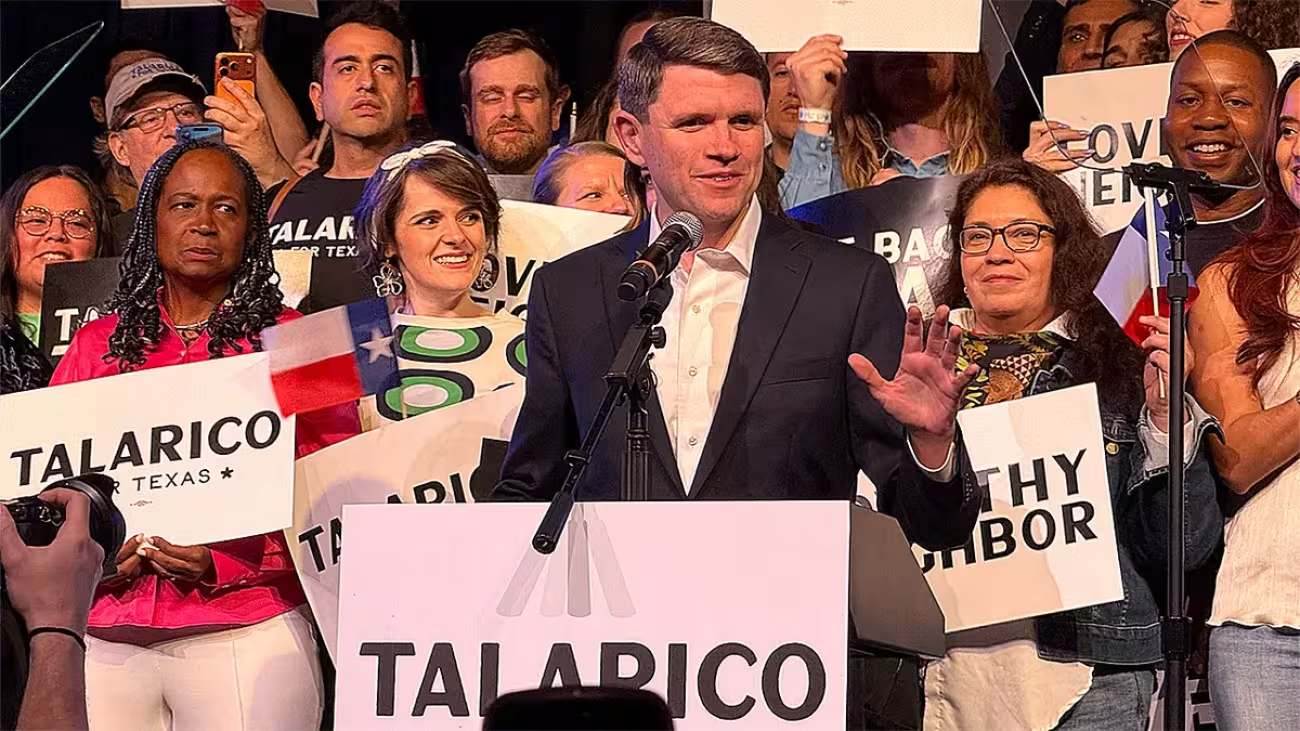
Updated October 11, 2026. James Talarico has become one of the most discussed figures in Texas political TikTok as the Democratic nominee for the state's closely watched 2026 U.S. Senate election. The 36-year-old state representative and Presbyterian seminarian has attracted a large online audience through videos about Christianity, public education, economic inequality and political division. His Republican opponent, Texas Attorney General Ken Paxton, has also become a recurring subject of viral clips, campaign attacks and online arguments about religion, character and the future of Texas politics.
The discussion extends far beyond the candidates' official accounts. Political influencers, commentators and ordinary TikTok users regularly circulate excerpts from speeches, interviews, debates and advertisements. Some offer detailed political analysis; others rely on humor, personal criticism or disputed allegations. With Election Day scheduled for November 3, 2026, these online conversations have become a prominent part of how the Senate contest is covered and understood.
The attention surrounding Talarico reflects a broader transformation in American election campaigns. Short-form videos can introduce candidates to audiences who rarely watch traditional political broadcasts, but the same platforms can accelerate misinformation and magnify controversies before the underlying facts are established.
Who Is James Talarico?
James Talarico is a Democratic politician from Texas who was first elected to the Texas House of Representatives in 2018. Raised in Round Rock, near Austin, he previously worked as a public school teacher and has frequently focused his legislative work and political messaging on education.
Talarico also studied at a Presbyterian seminary, a background that has become central to his public identity. Unlike politicians who largely separate religious discussion from campaign communication, he regularly invokes Christian teachings to explain his positions on economic justice, immigration, public services and individual rights.
His speeches have attracted substantial attention on TikTok, where excerpts from legislative hearings and discussions about religion circulate well beyond his immediate political supporters.
In March 2026, Talarico defeated U.S. Representative Jasmine Crockett in the Democratic Senate primary. He subsequently advanced to the general election against Republican nominee Ken Paxton.
Why Is James Talarico So Popular on TikTok?
Talarico's social media visibility developed before his Senate nomination. His account attracted viewers through speeches addressing controversial political questions with references to the Bible, public policy and personal beliefs.
Rather than relying exclusively on advertisements created for social media, many of his widely shared videos originated from legislative proceedings, sermons and public appearances.
The material lends itself to short-form distribution because individual statements can be clipped, captioned and shared without requiring viewers to watch an entire speech.
His Religious Arguments Generate Debate
Faith is one of the most recognizable themes in Talarico's online presence.
He has argued that Christian teachings about compassion and caring for neighbors support policies intended to address poverty, discrimination and economic inequality.
Conservative critics disagree with some of his interpretations of Scripture, particularly regarding abortion, LGBTQ+ rights and the relationship between religion and government.
These theological disagreements frequently move from campaign events to TikTok, where users respond with their own interpretations, rebuttals and reaction videos.
The result is a political conversation that involves religious identity as well as conventional campaign issues.
His Videos Reach Audiences Beyond Texas
By early March 2026, Talarico had approximately 1.6 million TikTok followers, according to reporting by WIRED and other news organizations.
That following gave him a substantial platform during the Democratic primary, although follower counts do not indicate how many viewers are registered Texas voters or support his candidacy.
His national visibility also increased following controversy surrounding a planned appearance on Stephen Colbert's late-night television program. The interview was released online after a network broadcasting decision involving equal-time considerations, attracting millions of views.
The attention illustrated how an appearance originally associated with traditional television could reach a much larger audience through digital distribution.
How TikTok Influencers Shaped the Democratic Primary
The influence of political content creators became particularly visible during the Democratic contest between Talarico and Jasmine Crockett.
Crockett had built a substantial social media following through forceful congressional exchanges and direct criticism of Republican politicians. Talarico's online identity, by comparison, was closely associated with measured speeches, biblical references and policy arguments.
The contrast became a recurring subject of online commentary. Influencers debated the candidates' political positions, styles of communication and approaches to representation.
Some discussions became increasingly personal, demonstrating how creators can shape campaign narratives without formally representing a candidate.
The Colin Allred Controversy
One notable controversy emerged in February 2026 when Dallas-based TikTok creator Morgan Thompson alleged that Talarico had referred to former Democratic Senate nominee Colin Allred as a "mediocre Black man."
The allegation spread widely online and prompted Allred to publish a response criticizing Talarico and endorsing Crockett.
Talarico disputed the characterization. He acknowledged criticizing Allred's campaign approach but said the allegation misrepresented a private conversation and denied making a race-based attack.
The disagreement quickly became a national political story.
The episode demonstrated how a single creator's account of a disputed private exchange could influence public discussion and prompt responses from established political figures before voters had access to independently verified evidence of the complete conversation.
It also highlighted the difficulty candidates face when claims circulate through loosely connected influencer networks rather than directly through official campaigns.
James Talarico vs. Ken Paxton: A Senate Race Dominating Online Debate
Following the Democratic primary, attention shifted toward the general election between Talarico and Paxton.
Paxton has served as Texas attorney general since 2015 and has been a prominent conservative figure through legal challenges involving federal policies, immigration, abortion and other political disputes.
Talarico and Paxton represent substantially different policy approaches, and their campaign messaging reflects those disagreements.
Religion and Christian Identity
Both candidates have emphasized Christianity, but they interpret its relationship to politics differently.
Talarico uses Christian teachings to discuss inclusion, poverty, pluralism and public responsibility. Paxton emphasizes conservative Christian principles, opposition to abortion and the protection of what he describes as America's religious heritage.
In August 2026, The Texas Tribune examined how the candidates' contrasting religious messages shaped their appeals to voters.
Those differences have produced viral exchanges and extensive commentary about whether religious values support particular political positions.
Economic and Social Policies
Beyond religion, the campaigns disagree about the role of government and several major policy areas.
Talarico has emphasized public education, health care access and economic pressures facing working families. Paxton has focused on conservative policies involving immigration enforcement, government regulation, abortion restrictions and opposition to Democratic federal priorities.
Their positions provide material for policy comparisons, although social media discussion frequently concentrates on shorter remarks and personal confrontations rather than complete legislative proposals.
What Do the Latest Texas Senate Polls Show?
Surveys published during September and early October 2026 have shown a competitive contest, with results varying across pollsters and sampling methods.
The University of Texas at Austin's Texas Politics Project compiles public polling for the race, including surveys of registered and likely voters.
| Polling Organization | Field Dates | Talarico | Paxton |
|---|---|---|---|
| YouGov | Sept. 28–Oct. 5 | 50% | 44% |
| Fox News | Sept. 24–28 | 51% | 49% |
| New York Times/Siena | Sept. 21–30 | 49% | 43% |
| NPR/Marist | Sept. 17–20 | 50% | 44% |
| Texas Southern University/YouGov | Sept. 15–19 | 47% | 46% |
The figures above follow the University of Texas polling compilation as updated October 6, 2026. Some other polling aggregators report differently adjusted or normalized figures for individual surveys.
The YouGov survey included 3,625 likely voters and reported a margin of error of approximately three percentage points.
Polling is a measurement of opinion during a particular period, not an election result. Differences in turnout assumptions, methodology and undecided voters can affect the relationship between a survey and the final vote.
Social media popularity is also a separate measurement: a politician can attract millions of followers without those followers representing the electorate participating in a Texas election.
Latest Controversy: Talarico's Absence From the Campaign Trail
In early October 2026, Talarico's temporary absence from in-person campaign events became a major subject of political discussion.
His campaign said he was recovering from the flu. As the absence continued, Paxton and other Republican figures publicly questioned his whereabouts.
Some online posts promoted unsupported speculation about the circumstances of the interruption, while Paxton's campaign used missing-person imagery and public requests for information as political criticism.
Talarico returned to public view at the Austin City Limits music festival on October 9, 2026, according to contemporaneous reporting.
His reappearance addressed the factual question of whether he had returned to campaigning, although debate about the candidates' messaging continued.
The episode provides another example of how online speculation can become a significant campaign story even when the original issue is a temporary absence from scheduled appearances.
Will James Talarico and Ken Paxton Debate?
The possibility of a direct debate has become another recurring subject in Texas political coverage.
Talarico has called for debates with Paxton, including a proposed appearance on Fox News.
Paxton's campaign has discussed possible debates but raised objections to certain arrangements and moderators.
During a campaign appearance in San Antonio, President Donald Trump also called for the candidates to debate. Talarico publicly responded by reiterating his willingness to participate.
As of October 11, no mutually confirmed debate schedule had been announced.
The absence of a scheduled debate has increased the importance of campaign advertisements, interviews and social media appearances as venues where the candidates explain and contest each other's positions.
AI-Generated Campaign Ads Raise New Questions
Artificial intelligence has introduced another complication into political video sharing.
In October 2026, the Financial Times reported on AI-generated political advertisements, including content associated with the Texas Senate race that depicted Talarico making statements through synthetic video.
AI-assisted political media can range from clearly labeled satire to fabricated appearances that viewers might mistake for genuine recordings.
The Wesleyan Media Project identified at least 164 AI-assisted political advertisements in its research, according to the Financial Times.
The growing use of synthetic content creates challenges for social media audiences because short video clips can circulate separately from their original disclosures or explanations.
Users evaluating controversial statements should distinguish authentic footage, edited excerpts, satire and AI-generated representations before treating a video as evidence of what a candidate actually said.
Celebrity Endorsements Add to the Online Conversation
Musicians and other public figures have also become part of the Texas Senate campaign's digital coverage.
In October 2026, Willie Nelson and the band Yo La Tengo were among the musicians publicly associated with endorsements of Talarico.
Yo La Tengo announced a benefit concert in Austin scheduled for October 27, while reporting also described previous support from Don Henley and the Chicks.
Such endorsements may increase a candidate's visibility outside conventional political audiences, although they do not independently establish how voters will behave in November.
They also generate additional online commentary, including support, criticism and debate over the relevance of celebrity political involvement.
Why the Texas Senate Race Matters Nationally
Texas has not elected a Democrat to statewide office since 1994, and Republicans have held the state's U.S. Senate seats for decades.
That history gives the 2026 contest national significance beyond the individual candidates.
Republicans and Democrats are competing for control of Congress, making closely watched Senate races important to both parties' broader electoral strategies.
Texas is also a large and politically diverse state, with significant differences among urban, suburban and rural communities.
The candidates' approaches to economic issues, religion and national policy are therefore being examined alongside questions about how the state's electorate has changed.
Social media provides a highly visible record of these disagreements, but a complete understanding of the election requires looking beyond online engagement to campaign policies, voter participation and verified polling.
Can TikTok Popularity Influence a Political Campaign?
TikTok can affect campaign communication by making speeches, advertisements and commentary available to viewers outside traditional news audiences.
Its short-form format also makes it easier for individuals to respond publicly to political statements, creating ongoing conversations among creators, journalists and supporters of different candidates.
However, viral reach does not provide a direct measurement of voter opinion.
View counts can include people outside Texas, users who cannot vote, repeat views and individuals watching because they disagree with the message.
Furthermore, social media algorithms personalize what users see, meaning two people following the same election may encounter substantially different political narratives.
These limitations matter when interpreting claims that a particular candidate dominates political discussion online.
Visibility can be measured through followers, video interactions and mentions, but determining whether that visibility changes election behavior requires additional research.
What Happens Next in the 2026 Texas Senate Race?
Texas voters are scheduled to cast ballots in the general election on November 3, 2026.
Before Election Day, both campaigns face continued scrutiny over policy differences, campaign spending, public appearances and the possibility of a candidate debate.
Additional polling may provide further information about voter preferences, although individual survey results will continue to require interpretation in light of sampling uncertainty.
On TikTok and other platforms, the discussion is also likely to include new advertisements, commentary and responses to campaign developments.
As of October 11, neither candidate has won the general election, and social media attention should not be presented as proof of the eventual outcome.
Conclusion
James Talarico's rise on Texas TikTok illustrates how social media has become intertwined with modern political campaigning. His speeches about faith, public policy and social issues have attracted a substantial online following, while disputes involving other Democrats, Republican criticism and campaign advertisements have kept him at the center of recurring debates.
The 2026 Texas Senate election between Talarico and Ken Paxton is also being shaped by matters that extend beyond online popularity, including policy disagreements, political spending, public debates and voter concerns.
For audiences following the race through TikTok, the challenge is to distinguish verified developments from opinions, edited clips and unsupported allegations. The platform provides extensive access to political discussion, but the election will ultimately be determined by voters on November 3.
- Log in to post comments