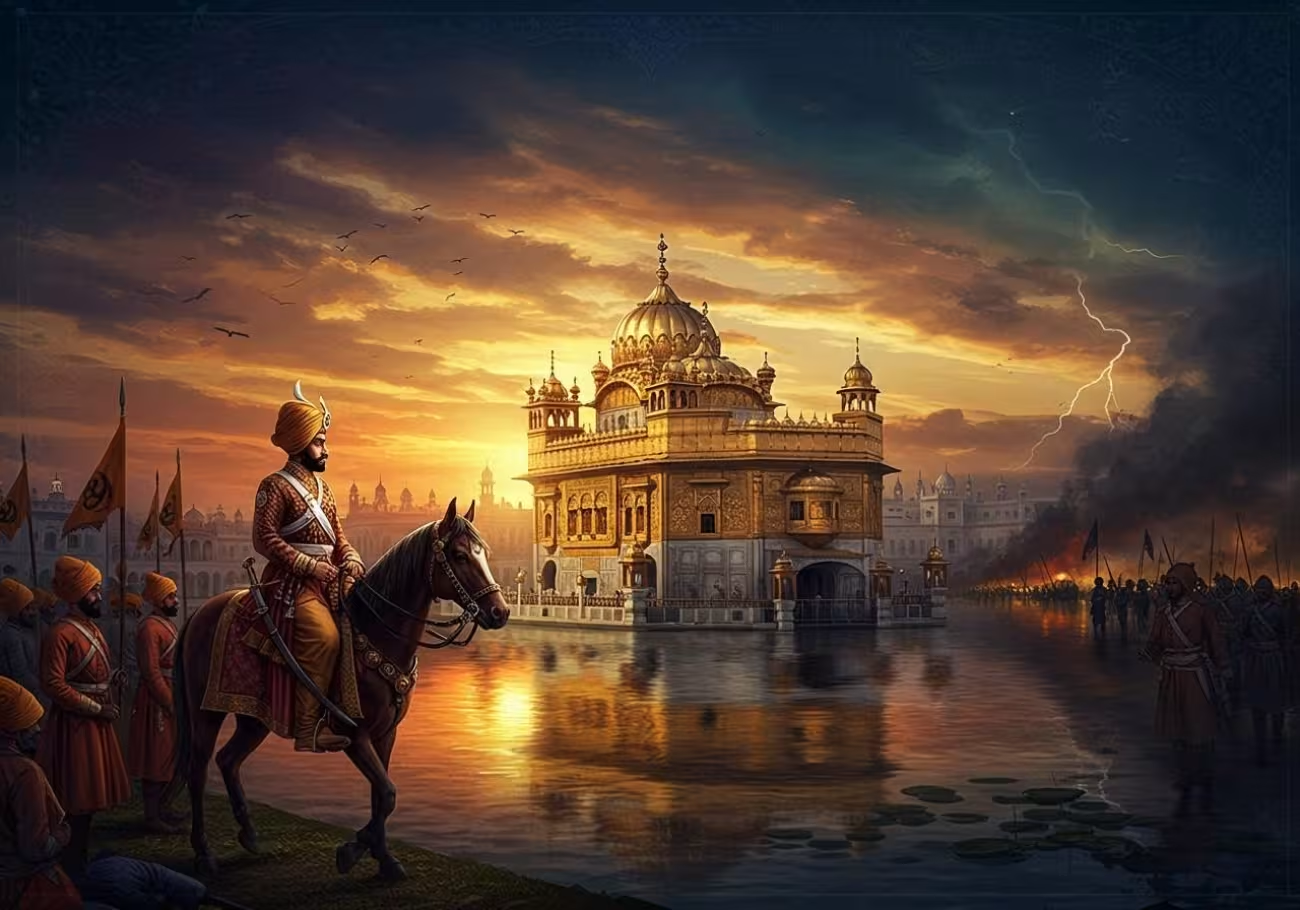
The Sikh Empire was an independent kingdom that ruled much of Punjab and surrounding territories from 1799 to 1849 under Maharaja Ranjit Singh and his successors. Although the empire disappeared following British annexation, its historical legacy continues to shape Sikh identity, politics in Punjab, and debates about autonomy and the Khalistan separatist movement. In October 2026, these historical questions remain relevant amid political disputes in India, renewed farmer mobilizations in Punjab, and international tensions surrounding Sikh separatist activism.
However, the modern Sikh community, the historical Sikh Empire, and the Khalistan movement are not interchangeable. Sikhism is a worldwide religion with diverse political perspectives, while Khalistan refers to a movement seeking an independent Sikh homeland. Recent protests in India likewise have different origins, ranging from agricultural policy disputes to electoral transparency. Understanding these distinctions is essential to explaining the region's past and present accurately.
Quick Facts About the Sikh Empire
| Historical Period | 1799–1849 |
|---|---|
| Founder | Maharaja Ranjit Singh |
| Capital | Lahore, now in Pakistan |
| Political System | Monarchy under the Sukerchakia dynasty |
| Major Territories | Punjab, Kashmir, Multan, Peshawar and adjoining regions |
| Last Maharaja | Duleep Singh |
| End of Independence | March 29, 1849 |
| Historical Successor | Territories incorporated into British India |
| Modern Historical Legacy | Sikh identity, Punjab politics and debates over self-determination |
How the Sikh Empire Rose to Power
The Sikh Empire emerged from the decline of Mughal authority in northern India during the 18th century. As Mughal power weakened, Sikh military confederacies known as misls expanded across Punjab and competed with Afghan rulers and other regional powers.
Ranjit Singh, born in Gujranwala in 1780, inherited leadership of the Sukerchakia Misl at a young age. Through military campaigns, political alliances and negotiations, he gradually united competing territories under his authority.
His capture of Lahore in 1799 established the foundation of a centralized kingdom. In 1801, he assumed the title of Maharaja of Punjab, beginning a period of expansion that transformed the region.
Ranjit Singh subsequently consolidated control over Amritsar, Multan, Kashmir and several frontier territories. His forces gained control of Attock in 1813, Multan in 1818, Kashmir in 1819 and Peshawar in 1834.
These conquests made the Sikh Empire an important power between the British-controlled territories of northern India and the Afghan regions to the northwest.
Why Maharaja Ranjit Singh Was Important
Ranjit Singh combined political centralization with military modernization. His government included Sikh, Hindu and Muslim officials, reflecting the religious diversity of Punjab.
Fakir Azizuddin, a Muslim diplomat, became one of his trusted advisers, while Dogra nobles and Hindu administrators occupied influential positions.
The Maharaja also recruited European officers to train infantry, cavalry and artillery units. These reforms helped create a military capable of confronting other organized armies in the region.
Although the kingdom was identified with Sikh political leadership, most of its inhabitants were not Sikh. The administration governed diverse religious communities and relied heavily on agricultural revenue, commerce and military organization.
The Fall of the Sikh Empire and British Annexation
Ranjit Singh died on June 27, 1839. His death triggered a succession crisis involving royal relatives, military commanders and powerful court factions.
Several rulers died or were removed during the following years. Kharak Singh succeeded his father but died in 1840. Nau Nihal Singh died shortly afterward, while Sher Singh was assassinated in 1843.
Duleep Singh became Maharaja as a child, leaving the monarchy vulnerable to competition among rival political and military interests.
Relations with the British East India Company deteriorated during this period. The First Anglo-Sikh War of 1845–1846 ended with British victory and extensive political restrictions on the Lahore government.
The Second Anglo-Sikh War of 1848–1849 brought the kingdom to an end. After the decisive Battle of Gujrat in February 1849, Sikh forces surrendered, and the British annexed Punjab on March 29, 1849.
The annexation dissolved the independent monarchy, but it did not erase Sikh religious institutions, cultural traditions or memories of the former kingdom.
From British Rule to the Partition of Punjab in 1947
British rule transformed Punjab's political institutions, military recruitment and agricultural economy. Sikh soldiers became an important part of the British Indian Army, while new irrigation projects and railway infrastructure changed the region's economic geography.
Meanwhile, Sikh religious reform organizations sought greater control over gurdwaras and the administration of religious institutions. The Gurdwara Reform Movement of the early 20th century was particularly significant in the development of modern Sikh political organization.
When British India was partitioned in August 1947, Punjab was divided between the newly independent countries of India and Pakistan.
The partition produced mass displacement and communal violence involving Muslims, Hindus and Sikhs. Large Sikh populations moved from West Punjab into India, while many Muslims migrated in the opposite direction.
Lahore, the former capital of the Sikh Empire, became part of Pakistan. Amritsar remained in India, creating a lasting division between two important centers of Sikh history.
The partition transformed the geography of Sikh political life and shaped later debates about religious identity, state boundaries and regional autonomy.
How the Khalistan Movement Developed
The Khalistan movement seeks the establishment of an independent Sikh homeland, generally associated with Punjab. It is a modern separatist political movement, not a direct continuation of the Sikh Empire's monarchy.
The movement emerged from a complex historical background involving Sikh political representation, language, regional autonomy, religious identity and disputes between Punjab-based organizations and India's central government.
After independence, Sikh political leaders participated in campaigns for a Punjabi-speaking state. These demands were not uniformly separatist; many sought administrative recognition and greater political representation within India.
The Punjabi Suba Movement
The Punjabi Suba movement called for a state organized around the Punjabi language. The campaign became an important political issue during the 1950s and 1960s.
In 1966, Punjab was reorganized, creating a smaller Punjab state and separating Haryana, while Chandigarh became a union territory serving as the capital of both states.
Although this reorganization addressed important linguistic demands, disputes over Chandigarh, river-water distribution and regional autonomy continued.
The Anandpur Sahib Resolution of 1973
In 1973, the Shiromani Akali Dal adopted the Anandpur Sahib Resolution, which called for greater authority for India's states and emphasized Sikh religious and cultural interests.
The resolution became highly controversial. Some political opponents portrayed it as separatist, while Akali leaders argued that its principal objective was federal autonomy rather than independence.
This distinction matters because demands for decentralization within India should not automatically be interpreted as support for establishing Khalistan.
The Rise of Sikh Militancy in the 1980s
Punjab experienced increasingly severe political violence during the late 1970s and early 1980s. Religious tensions, competition among political parties, militant mobilization and disputes with the central government contributed to instability.
Jarnail Singh Bhindranwale emerged as an influential Sikh religious preacher associated with a radicalizing political environment.
His role remains a subject of historical controversy. Supporters have portrayed him as a defender of Sikh identity, while critics associate him and armed followers with the escalation of militancy and attacks on civilians.
Some separatist groups explicitly advocated an independent Khalistan, while other Sikh political organizations continued pursuing constitutional and regional objectives.
Armed organizations carried out assassinations, attacks on Hindu civilians and bombings. The violence also affected Sikhs who opposed militants or became caught in rivalries among armed factions.
By 1984, militants had established positions within the Golden Temple complex in Amritsar, creating a confrontation with the Indian government.
Operation Blue Star: The June 1984 Military Assault
Operation Blue Star was an Indian military operation conducted in June 1984 to remove armed militants from the Golden Temple complex and other locations in Punjab.
The operation was authorized by Prime Minister Indira Gandhi's government after escalating violence and the failure of political efforts to resolve the confrontation.
Indian troops entered the Golden Temple complex, where armed militants, including Bhindranwale, had established defensive positions.
Heavy fighting caused substantial casualties and damage to the religious site, including the Akal Takht, a major institution of Sikh religious authority.
The number of people killed remains disputed. Government accounts, independent investigations and Sikh organizations have presented different estimates, partly because civilians, pilgrims, militants and security personnel were present during the operation.
The assault deeply affected Sikh communities in India and abroad. Many regarded the use of military force within Sikhism's most revered religious complex as a profound violation, including Sikhs who did not support armed separatism.
Operation Blue Star became a major turning point in the relationship between sections of the Sikh community and the Indian state.
The Assassination of Indira Gandhi and the 1984 Anti-Sikh Massacres
On October 31, 1984, Prime Minister Indira Gandhi was assassinated by two Sikh members of her security detail, Beant Singh and Satwant Singh.
The assassination was followed by organized attacks against Sikh civilians, particularly in Delhi.
Over several days, mobs targeted Sikh neighborhoods, homes, businesses and religious institutions. Victims were beaten, burned and killed, while survivors reported widespread sexual violence and displacement.
According to the official death count for Delhi, at least 2,733 Sikhs were killed. Hundreds more died elsewhere in India.
Human Rights Watch has documented evidence that some political figures and police personnel were complicit in the violence or failed to intervene effectively.
The events are often described as the 1984 anti-Sikh riots, although many survivors and human rights advocates prefer terms such as massacres or pogroms because the attacks were directed against a particular religious community.
Multiple government inquiries investigated the violence. However, criminal accountability proceeded slowly, and human rights organizations criticized the failure to prosecute many of those allegedly responsible.
The massacres remain central to Sikh historical memory and discussions about justice, minority protection and state accountability.
The Punjab Insurgency and Counterinsurgency, 1984–1995
The years following 1984 saw an extended armed conflict involving Sikh separatist organizations and Indian security forces.
Militant groups carried out attacks on civilians, security personnel and political figures. Some organizations also employed kidnapping, extortion and intimidation.
Indian authorities expanded counterinsurgency operations to dismantle armed networks and restore state control.
The conflict resulted in widespread abuses committed by different actors. Human Rights Watch documented militant attacks on civilians alongside unlawful detentions, torture, enforced disappearances and extrajudicial killings attributed to security forces.
Human rights investigators also uncovered allegations that police secretly cremated the bodies of people who had died in custody or had been killed during counterinsurgency operations.
Tens of thousands of people died during the wider conflict, although exact totals vary depending on the period and categories included.
By the mid-1990s, the organized armed insurgency had substantially diminished. Punjab gradually returned to more regular electoral politics and civilian administration.
Nevertheless, the conflict left unresolved questions about missing persons, accountability, historical memory and the treatment of political dissent.
Does the Sikh Empire Still Exist Today?
No. The Sikh Empire ceased to exist as an independent political entity in 1849.
Its former territories are now divided principally between India and Pakistan. Lahore, once its capital, is part of Pakistan, while Amritsar and much of the eastern Punjab heartland are located in India.
Punjab today is an Indian state with an elected government operating within India's constitutional system. Pakistan also has a province called Punjab, which contains Lahore and many important historical sites associated with Sikh rule.
The historical empire therefore survives through architecture, historical scholarship, religious institutions and cultural memory rather than through a functioning monarchy or an internationally recognized successor state.
What Is Happening in Punjab in October 2026?
As of October 11, 2026, Punjab's political environment includes several overlapping but distinct issues: agricultural protests, demands concerning regional resources, debate over Sikh identity and Khalistan, and security concerns involving alleged separatist activity.
These developments should not be understood as a single rebellion. There is no verified evidence in the reporting reviewed for this article that Punjab has returned to an armed separatist insurgency comparable to the violence of the 1980s and early 1990s.
Farmer Protests in September and October 2026
Farmers' organizations staged demonstrations across Punjab during September 2026 over agricultural prices, debt relief, land policies, international trade agreements and water management.
Beginning September 1, the Samyukta Kisan Morcha organized a seven-day protest along the Chandigarh-Mohali border.
Participants demanded a legally guaranteed Minimum Support Price for crops, agricultural debt relief, higher sugarcane payments and stronger protections for farmers affected by changing economic policies.
Other concerns included river-water agreements, irrigation infrastructure, the Dam Safety Act and proposals affecting agricultural land.
The demonstrations included tractor trolleys, temporary protest camps and community kitchens, reflecting methods that have become familiar in major Indian farmers' movements.
On September 7, participating organizations ended the week-long blockade after the Punjab government provided written assurances and agreed to further consideration of several demands.
However, agricultural mobilization continued through separate organizations. In early October, members of Bharatiya Kisan Union (Ekta-Ugrahan) blocked administrative offices in parts of Punjab.
That protest was called off on October 6 after government representatives arranged talks for October 13.
These demonstrations were primarily economic and political protests. Their demands should not be categorized as calls for Khalistan without evidence linking a particular organization or event to separatist objectives.
Fresh Concerns About Khalistan-Related Activity
Although the large-scale insurgency of the 1980s has ended, Indian authorities continue to investigate individuals and organizations accused of promoting Khalistan-related violence or carrying out associated criminal activities.
A May 2026 country-information report from Canada's Immigration and Refugee Board documented arrests and police investigations involving alleged Khalistan supporters in Punjab, Haryana and Delhi.
Among the cases discussed were allegations of pro-Khalistan graffiti, vandalism and links to the organization Sikhs for Justice.
In January 2026, Delhi Police arrested two men suspected of painting separatist slogans at public locations. The allegations were subsequently discussed in court proceedings, while one accused individual denied criminal involvement.
Such cases show that Khalistan-related political and security disputes remain active. However, arrests, allegations and propaganda incidents are not sufficient evidence of a renewed region-wide insurgency.
It is also important to distinguish peaceful political expression from allegations involving violence, intimidation or other criminal conduct.
Why Khalistan Remains an International Issue
The Khalistan debate extends beyond India because substantial Sikh communities live in countries including Canada, the United Kingdom, the United States and Australia.
Some diaspora organizations support the creation of an independent Sikh state and organize political campaigns or unofficial referendums.
Other Sikh organizations focus on religious education, human rights, community services or cultural preservation without advocating separation from India.
The political diversity of these communities makes it inaccurate to treat Sikh diaspora activism as uniformly separatist.
The Killing of Hardeep Singh Nijjar in Canada
One of the most consequential international controversies involved Hardeep Singh Nijjar, a Canadian Sikh activist associated with the Khalistan movement.
Nijjar was shot dead outside a gurdwara in Surrey, British Columbia, on June 18, 2023.
In September 2023, then-Canadian Prime Minister Justin Trudeau said Canadian authorities were investigating credible allegations of a possible connection between agents of the Indian government and Nijjar's killing.
India rejected those allegations, describing them as unfounded.
The dispute severely damaged diplomatic relations, contributing to the expulsion of diplomats and increased scrutiny of alleged foreign interference.
Major Developments in the Nijjar Case During 2026
On July 7, 2026, United States prosecutors announced charges against Indian gang leader Lawrence Bishnoi and associate Satinderjeet Singh, also known as Goldy Brar, in connection with Nijjar's murder.
The indictment alleged that Bishnoi directed the killing while imprisoned in India and that his associate helped organize criminal operations in North America.
These are criminal allegations, not findings of guilt. The indictment also did not accuse the Indian government of involvement in the killing.
On July 14, India's foreign ministry said it remained committed to cooperation against transnational organized crime.
Meanwhile, Canada and India have been working to restore diplomatic and commercial relations. In September 2026, Canadian officials expressed optimism about reaching a bilateral trade agreement by the end of the year.
The diplomatic improvement does not mean every allegation connected to Nijjar's death or the security of Sikh activists has been resolved.
Threat Warnings to Sikh Activists in 2026
In August 2026, Gurpatwant Singh Pannun, a prominent lawyer and figure associated with Sikhs for Justice, said Canadian police had provided another warning about a credible threat to his life.
He also reported receiving a warning from the FBI.
The reported warnings illustrate continuing security concerns surrounding prominent Khalistan advocates abroad. However, the existence of a threat warning does not independently establish who was responsible for a threat or the motive behind it.
The October 2026 Delhi Protests and the Sikh Gurdwara Controversy
On October 10, 2026, New Delhi experienced widespread demonstrations over a disputed revision of India's electoral rolls.
The protests were organized by the youth-led Cockroach Janta Party, which demanded the resignation of Chief Election Commissioner Gyanesh Kumar.
Opposition parties alleged that voter-list revisions had removed large numbers of eligible voters, while the Election Commission and the governing Bharatiya Janata Party denied wrongdoing.
Police restricted access to Jantar Mantar, the intended demonstration site, deployed substantial security forces, temporarily closed transport facilities and detained thousands of participants.
Reuters reported more than 2,000 detentions, while accounts from other organizations and subsequent reporting cited different totals.
Why Gurdwara Bangla Sahib Became Involved
Some demonstrators gathered at or sought refuge in Gurdwara Bangla Sahib, a major Sikh religious institution in central Delhi.
Gurdwaras traditionally welcome visitors from different religious backgrounds and often provide free meals through community kitchens known as langars.
The use of the gurdwara as a temporary refuge reflected this broader religious and humanitarian role.
Although the incident generated disagreement over the conduct of police near religious premises, the electoral-roll protests were not organized as a Khalistan rebellion or a campaign to restore the Sikh Empire.
The distinction is important because the presence of a Sikh religious institution during a protest does not establish the political identity or objectives of the demonstrators.
How Modern Sikh Politics Differs From the Khalistan Movement
Modern Sikh politics includes several institutions and organizations with different objectives.
The Shiromani Gurdwara Parbandhak Committee is closely associated with the administration of major Sikh religious institutions.
The Shiromani Akali Dal has historically played a significant role in Punjab politics and Sikh political representation, although its leadership, alliances and electoral influence have changed over time.
Punjab's state government operates within India's democratic and constitutional framework, and political parties compete over public services, agriculture, employment, education and other issues.
Khalistan-oriented organizations represent a separate strand of political activity. Some advocate independence through political organizing, while Indian authorities have accused particular groups or individuals of involvement in violent or unlawful activities.
Support for Sikh religious identity, regional autonomy or the preservation of Punjab's cultural heritage should not automatically be interpreted as endorsement of separatism.
Why Punjab Continues to Experience Political Tensions
Punjab's contemporary challenges reflect a combination of economic, historical and political factors.
Agricultural Dependence and Rural Debt
The agricultural economy remains central to Punjab's society and politics. Dependence on wheat and rice cultivation exposes farmers to changing procurement policies, input costs and concerns about water availability.
Debt and the demand for reliable agricultural prices have therefore generated recurring protests.
Water-Sharing and Regional Autonomy
Disputes over river-water allocation and central-state authority have persisted for decades.
These issues are connected to Punjab's agricultural dependence and longstanding political debates about regional rights.
Memory of the 1980s Conflict
The events of 1984 and subsequent counterinsurgency operations continue to influence public discussions about justice, security and political trust.
Unresolved allegations of unlawful killings and disappearances remain particularly significant for affected families.
Overseas Political Mobilization
Sikh communities abroad have helped preserve historical memory and bring international attention to human rights concerns.
At the same time, disagreements over Khalistan and allegations of transnational intimidation have complicated India's relations with several foreign governments.
Could the Sikh Empire Be Restored?
The historical Sikh Empire no longer exists, and there is no internationally recognized process underway to restore Ranjit Singh's monarchy.
Modern proposals associated with Khalistan concern the creation of a separate state, rather than a straightforward restoration of the 19th-century kingdom.
Any attempt to change India's territorial boundaries would face major constitutional, political, diplomatic and security questions.
The historic empire also occupied territories that are now divided between India and Pakistan, making comparisons between its former boundaries and modern separatist proposals especially complicated.
More broadly, historical admiration for Maharaja Ranjit Singh does not demonstrate support for a particular modern political movement.
The Sikh Empire's Legacy in the Modern World
The Sikh Empire remains historically important because it united much of Punjab under a strong regional monarchy and maintained independence during a period of expanding British colonial power.
Its legacy survives in historic buildings, religious institutions, artistic traditions and the political memory of Punjab.
Modern disputes involving Khalistan, agricultural protests and political rights draw on different combinations of regional identity, historical experience and contemporary grievances.
The history of Sikh communities cannot be reduced to armed militancy or separatist politics. It also encompasses religious scholarship, cultural development, commerce, agriculture, military service, migration and public institutions.
Understanding the distinction between the former empire, Sikh religious identity and modern political movements provides a clearer explanation of why Punjab remains significant within India and across the international Sikh diaspora.
Conclusion
The Sikh Empire reached its height under Maharaja Ranjit Singh before falling to British rule in 1849. Its disappearance marked the end of an independent Punjabi monarchy, but the region's subsequent history continued to be shaped by religious identity, partition, demands for autonomy and political conflict.
The Khalistan movement developed in a very different historical environment, with violence escalating in the 1980s and triggering a period of insurgency and counterinsurgency that caused widespread suffering. The 1984 anti-Sikh massacres and unresolved human rights abuses remain particularly important elements of this history.
As of October 2026, Punjab faces ongoing political and economic disputes, while Khalistan-related activism continues to generate controversy within India and abroad. Recent farmer demonstrations and protests in Delhi, however, have their own immediate causes and should not be automatically classified as Sikh separatist unrest.
The connection between past and present lies not in the continuation of the Sikh Empire as a state, but in the enduring historical significance of Punjab and the diverse ways its communities understand identity, political authority and their relationship with modern India.
- Log in to post comments