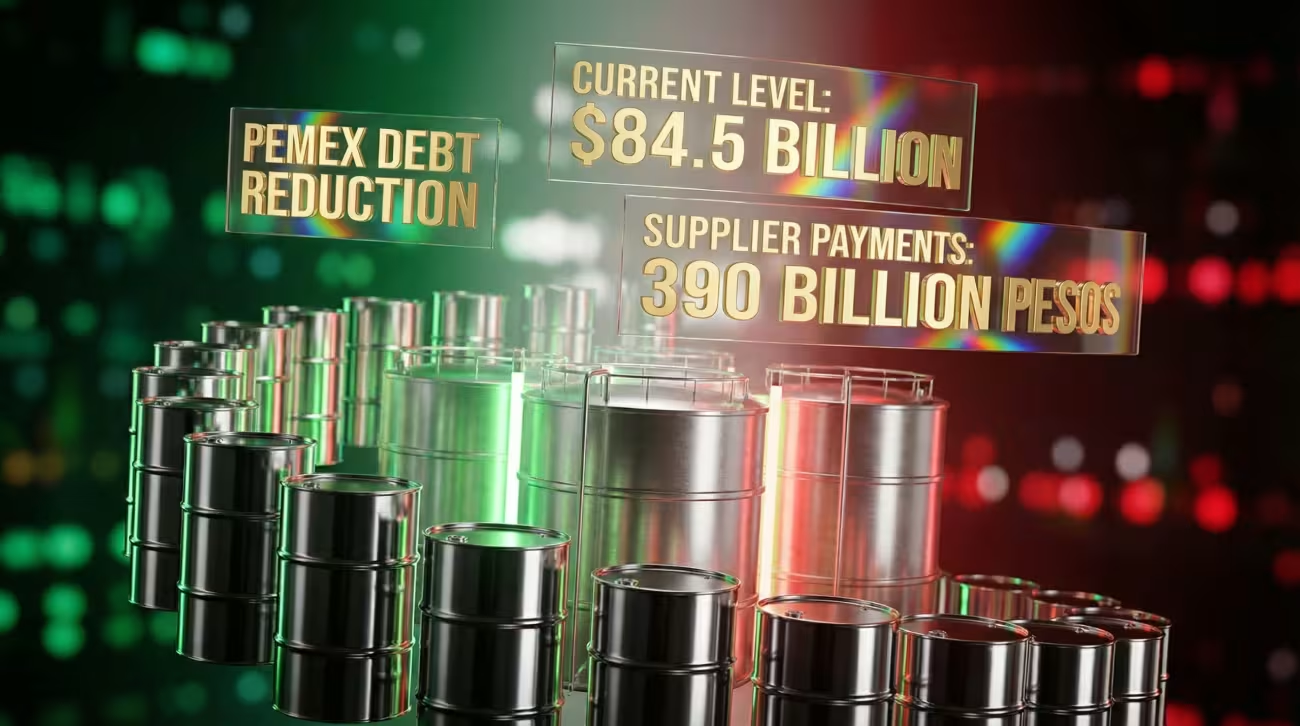
Mexico's state-owned oil company, Petróleos Mexicanos (Pemex), has made progress in reducing its enormous financial debt, but its broader financial problems remain unresolved. Its third-quarter 2026 results, released on October 30, showed that financial debt had fallen to approximately $77.6 billion, compared with around $100 billion a year earlier. However, the company still recorded a net loss of 10.8 billion pesos, equivalent to roughly $600 million, while its outstanding obligations to suppliers and contractors remained substantial. Government financial assistance also continued, highlighting Pemex's dependence on public resources. The company faces several interconnected challenges, including declining output from mature oil fields, insufficient investment, refinery inefficiencies, high operating costs and long-standing payment obligations. President Claudia Sheinbaum's administration has introduced debt restructuring, government financing and mixed-investment arrangements with private companies to stabilize the oil giant. Although these measures have improved some financial indicators, Pemex has yet to demonstrate that it can generate sufficient cash independently to sustain its operations, invest in production and meet its obligations without continued government assistance.
What Is Pemex and Why Is It Important to Mexico?
Petróleos Mexicanos, commonly known as Pemex, is Mexico's state-owned oil and gas company. It plays a central role in the country's energy industry and has historically been one of the most important contributors to public revenue.
Established in 1938 following the nationalization of Mexico's petroleum industry, Pemex became a symbol of national control over natural resources and energy sovereignty.
The company operates across the petroleum value chain, including exploration, crude oil production, natural gas extraction, refining, transportation, storage and fuel distribution.
Its activities are particularly important because Mexico remains a major oil-producing country, while domestic energy demand requires a substantial supply of gasoline, diesel and other refined products.
For successive Mexican governments, Pemex has represented more than a commercial enterprise. It is closely connected to national energy policy, industrial development and political debates about the country's control over its natural resources.
This strategic importance explains why the government has repeatedly intervened to support the company rather than allowing its financial difficulties to develop into a broader energy crisis.
Why Pemex Has Been Struggling for Years
Pemex's financial difficulties developed over several decades and reflect a combination of excessive debt, declining production, insufficient investment and operational inefficiencies.
One of its most significant problems is the natural decline of mature oil fields. Many of Mexico's established reservoirs have been producing for decades, and maintaining output requires continuous investment in drilling, enhanced recovery and new exploration.
However, financial constraints have limited the company's ability to invest consistently in these activities.
At the same time, Pemex has struggled with aging infrastructure, expensive maintenance, refinery interruptions and high operating costs.
The company has also accumulated substantial obligations to contractors and suppliers, creating problems throughout its production and maintenance operations.
These difficulties reinforce one another. Lower production reduces potential revenue, while debt payments and unpaid invoices restrict the money available for new investment.
Without sufficient investment, existing fields continue to decline and equipment becomes increasingly difficult to maintain.
This structural cycle has made Pemex dependent on repeated government assistance.
Pemex's Third-Quarter 2026 Financial Results
Pemex released its financial results for the third quarter of 2026 on October 30, providing a clearer picture of the company's latest financial position.
Revenue increased by 28.5% year over year to approximately 487 billion Mexican pesos, equivalent to around $25.9 billion.
Despite the increase in revenue, Pemex reported a net loss of approximately 10.8 billion pesos, or around $600 million.
The loss was substantially smaller than the 61.247 billion pesos recorded during the same period in 2025.
The financial result was affected by several factors, including the depreciation of the Mexican peso and higher payments to the federal government related to hydrocarbon extraction.
The figures demonstrated that stronger revenue does not necessarily translate into profitability.
For Pemex, improving its financial position requires more than selling additional oil. The company must also control costs, improve operating efficiency and generate sufficient cash to cover its obligations.
Pemex's Financial Debt Fell to $77.6 Billion
One of the more encouraging developments was the reduction in Pemex's financial debt.
At the end of September 2026, the company reported financial debt of approximately $77.6 billion.
This represented a significant decline from approximately $100 billion a year earlier and reflected government-backed financing operations, debt management measures and other financial interventions.
The reduction is important because a smaller debt burden can reduce interest expenses and provide additional room for operational investment.
However, the figure must be interpreted carefully.
Financial debt is not the same as total liabilities. Pemex also has outstanding obligations to suppliers, contractors, employees and pension beneficiaries.
Consequently, the reduction in financial borrowing does not mean that all of the company's financial problems have been resolved.
In addition, part of the improvement resulted from government support and financial restructuring rather than a fundamental transformation of the company's operating model.
The Government Continues to Finance Pemex
The Mexican government remains central to Pemex's financial survival.
President Claudia Sheinbaum's administration has provided financial assistance through capital contributions, debt management operations and other liquidity arrangements.
In its October 2026 assessment of Mexico, the International Monetary Fund reported that Pemex's financial obligations had declined from approximately $98 billion in 2024 to around $78 billion in June 2026.
The reduction included a government-financed buyback worth approximately $10 billion.
The IMF also noted that government transfers to cover debt amortization remained necessary, with approximately 195 billion pesos budgeted for this purpose in 2026.
These measures have helped reduce immediate refinancing pressure, but they demonstrate that Pemex has not yet become financially independent.
Government assistance is particularly important because the company has limited internal cash generation relative to its operational and financing requirements.
Unpaid Suppliers Remain a Major Problem
Another serious challenge is Pemex's substantial debt to contractors and suppliers.
These businesses provide essential services, including drilling, engineering, equipment, transportation, maintenance and infrastructure development.
Delayed payments can create financial problems for smaller contractors that depend on Pemex for a significant portion of their business.
According to Pemex's third-quarter reporting, the outstanding balance owed to suppliers had declined by approximately 103 billion pesos compared with the same period in 2025.
However, El País reported that supplier and contractor obligations still amounted to approximately 414.2 billion pesos at the end of September 2026.
Earlier in the year, Pemex had restructured approximately 255.4 billion pesos in supplier obligations under an arrangement extending repayment schedules for up to eight years.
Reuters reported that the restructuring was intended to spread payments over a longer period, with quarterly principal and interest payments.
Although the arrangement can improve short-term liquidity, it also means that contractors must wait longer to recover money already owed to them.
For Pemex, restoring confidence among suppliers is essential. Companies that are uncertain about receiving payment may become reluctant to accept new contracts or finance additional projects.
Claudia Sheinbaum's Plan to Rescue Pemex
President Claudia Sheinbaum inherited Pemex's financial and operational problems when she took office in October 2024.
Her administration has attempted to stabilize the company while maintaining state ownership and control over Mexico's strategic energy resources.
The government has pursued several measures, including financial restructuring, debt reduction, increased operational investment and partnerships with private companies.
Rather than fully privatizing Pemex, the administration has promoted mixed-investment arrangements in which private partners can contribute capital, technical expertise and operational resources to selected projects.
The objective is to distribute investment costs and operational risks while retaining government control over strategic assets.
This approach acknowledges that Pemex does not have sufficient financial resources to undertake every exploration, production and infrastructure project independently.
However, the effectiveness of the strategy depends on whether private companies consider the contractual terms sufficiently attractive and predictable.
Why Private Investors Are Still Cautious
Private investors have several reasons to remain cautious about participating in Pemex projects.
First, the company's history of delayed payments creates concerns about the reliability of its contractual commitments.
Second, energy projects often require substantial upfront investment and years of development. Companies therefore need confidence that government policies and commercial agreements will remain stable.
Third, Mexico's energy sector has been shaped by strong political support for state ownership, making the role of private investment a sensitive issue.
Investors also need clarity about how project revenues, operational costs and risks will be distributed between Pemex and private partners.
Without transparent agreements and reliable payment mechanisms, private companies may choose to invest in other markets instead.
Mixed-Investment Contracts Aim to Increase Production
Mexico has introduced mixed-investment contracts to encourage private participation in exploration and production.
The strategy includes projects involving existing fields, where geological information is already available and additional investment could help improve recovery rates.
By focusing on established reserves, the government hopes to increase output without relying entirely on expensive and uncertain exploration projects.
During 2026, Pemex continued developing partnerships involving exploration, production and technical services.
These arrangements could provide additional capital and expertise, but their contribution to the company's recovery will depend on the speed of implementation and the quality of project execution.
The IMF has also warned that maintaining production will require substantially greater investment because Mexico's proven, probable and possible reserves have declined.
According to the IMF's October 2026 assessment, 3P reserves fell from 20.4 billion barrels in 2019 to 17.3 billion barrels in 2025.
The report also noted that only about one-third of the annual exploration and extraction investment budget had been executed during the first half of 2026.
This underinvestment represents a significant obstacle to long-term production growth.
Oil Production and the Challenge of Mature Fields
Maintaining oil production has been one of Pemex's most persistent operational challenges.
Many of its established fields have entered mature production stages, meaning that output naturally declines as reservoirs become depleted.
New exploration and development projects have not consistently replaced the production lost from older fields.
According to Pemex's third-quarter 2026 announcement, total hydrocarbon production increased by 2.6% compared with the third quarter of 2025.
Natural gas production also exceeded five billion cubic feet per day for the first time since the second quarter of 2023, supported by the Bakté and Ixachi fields.
These developments indicate that some parts of the upstream business have improved.
However, production stabilization should not be confused with a complete recovery. Sustaining output over the coming years will require continuous investment in exploration, field development and recovery technologies.
Refinery Problems Have Complicated Mexico's Energy Strategy
Pemex's problems extend beyond oil extraction. Its refining operations have also struggled with aging equipment, insufficient maintenance and operational interruptions.
Mexico has invested heavily in expanding domestic refining capacity as part of its strategy to reduce dependence on imported gasoline and diesel.
However, the performance of existing facilities has remained inconsistent.
In September 2026, Reuters reported that refinery output had deteriorated during the second quarter, prompting President Sheinbaum to confront senior energy and finance officials.
Diesel production fell 11% and gasoline production declined 13% compared with the previous quarter, according to the data cited in the report.
Diesel imports increased 134%, while gasoline imports rose 45% during the same period.
These figures highlighted the difficulty of achieving energy self-sufficiency when domestic refining facilities cannot consistently operate at their intended capacity.
However, Pemex's own third-quarter announcement later reported stronger refining performance, with crude processing and gasoline and diesel production reaching their highest levels since 2014.
The contrasting quarterly figures demonstrate why production and refining performance must be assessed over time rather than through a single reporting period.
Industrial Accidents Raise Questions About Safety and Maintenance
Operational reliability and industrial safety are also major concerns for Pemex.
Reuters reported in September 2026 that multiple refinery accidents during the year had caused fatalities and injuries.
The incidents raised questions about the condition of industrial equipment, maintenance schedules and the availability of spare parts.
The Olmeca refinery in Tabasco, one of Mexico's major recent energy investments, experienced operational problems and fires.
A March 2026 incident involving an overflow of oily wastewater killed five people, according to Reuters.
These incidents have increased pressure on Pemex to improve safety management and maintenance practices.
Production improvements will be difficult to sustain if the company cannot maintain reliable and safe industrial operations.
What Do Moody's and Other Credit Rating Agencies Say?
Credit rating agencies continue to view government support as a decisive factor in Pemex's financial position.
In May 2026, Moody's maintained Pemex's B1 rating with a stable outlook.
The agency warned that financial needs would remain high through at least 2028 and that weak operating performance could result in sustained negative free cash flow.
Moody's also highlighted the depletion of mature reserves, insufficient investment and the structural problems affecting the refining business.
Pemex's September 2026 credit rating information showed that Fitch maintained a BB+ rating with a stable outlook, while Moody's maintained B1 with a stable outlook.
Standard & Poor's listed a BBB rating with a negative outlook in the company's published credit ratings information.
These ratings are not directly interchangeable because each agency applies its own methodology and scale.
Nevertheless, the assessments indicate that the company remains exposed to significant financial and operational risks, despite the improvement in its reported debt position.
Why Pemex Matters to Mexico's Public Finances
Pemex's financial problems have implications far beyond the oil industry.
Because the company is strategically important and heavily dependent on government support, its financing needs can affect Mexico's public spending priorities.
Large government transfers may help prevent a corporate liquidity crisis, but they also consume resources that could otherwise be used for infrastructure, healthcare, education and other public services.
The company's financial difficulties also create uncertainty for investors assessing Mexico's fiscal position.
The IMF's October 2026 report recognized that recent financial operations had reduced Pemex's debt but emphasized that continued sovereign support remained necessary.
This means the government's exposure has not disappeared simply because the company's reported financial debt has declined.
The challenge is to transform financial support into sustainable operational improvements rather than perpetuating a cycle of recurring bailouts.
Can Pemex Become Financially Independent?
Whether Pemex can eventually operate without substantial government assistance remains uncertain.
The company has reduced financial debt and improved several operating indicators, but its latest financial results still show a net loss.
Its obligations to suppliers remain substantial, and investment requirements in exploration, production and refining continue to exceed what the company can comfortably finance through internal cash generation.
Moody's projection of negative free cash flow through 2028 illustrates the scale of the challenge.
To achieve financial independence, Pemex must improve production efficiency, reduce operating costs, maintain reliable refineries, increase investment productivity and establish sustainable payment arrangements with contractors.
It must also demonstrate that new private partnerships can generate additional production and revenue rather than merely provide temporary financing.
What Comes Next for Mexico's Oil Giant?
Pemex enters the final months of 2026 with a stronger reported debt position but continuing structural problems.
The reduction in financial debt is an important development, and the improvement in third-quarter operating indicators provides some reason for optimism.
However, the company's net loss and substantial supplier obligations demonstrate that its recovery remains incomplete.
The government will need to balance continued financial support against the need to protect public finances and encourage private investment.
At the same time, Pemex must demonstrate that it can turn additional investment into higher and more reliable production, safer industrial operations and stronger cash flow.
The central question is no longer simply whether Mexico can prevent Pemex from defaulting on its obligations. It is whether the company can become an efficient and financially sustainable energy enterprise.
Until that transformation takes place, Pemex will remain one of the most significant economic and fiscal challenges facing Mexico.
- Log in to post comments