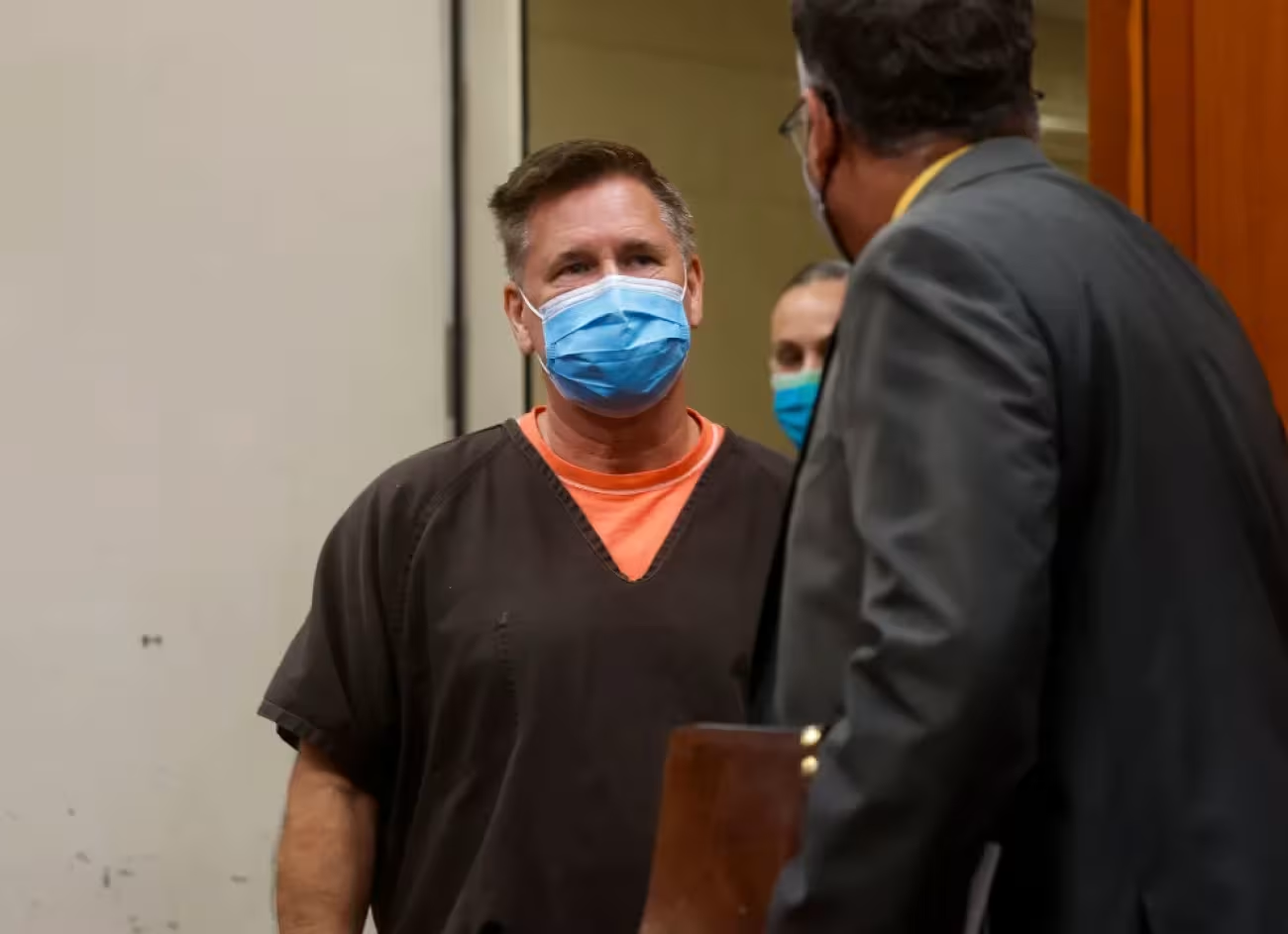
More than three decades after Adobe Systems engineer Laurie Houts was found strangled inside her car in Mountain View, California, her murder remains at the center of an unresolved criminal case. John Kevin Woodward, who lived with Houts's boyfriend at the time, was identified as a suspect shortly after the September 5, 1992, killing. Prosecutors initially relied on fingerprints, clothing fibers and a suspected jealousy motive, but two separate jury trials in the 1990s ended without unanimous verdicts. In August 1996, a judge dismissed the case, citing insufficient evidence. The investigation was revived in 2022 after modern DNA testing linked Woodward's genetic profile to material recovered from the rope used in the killing. However, a renewed prosecution triggered a prolonged constitutional dispute over whether trying him again would violate the Fifth Amendment's protection against double jeopardy. In March 2026, a federal judge halted the proposed third trial while reviewing Woodward's habeas corpus petition. A September 2026 report by The Mercury News indicated that the legal dispute was still unresolved, leaving Laurie Houts's family waiting for a possible trial more than 34 years after her death.
Who Was Laurie Houts?
Laurie Anne Houts was a 25-year-old computer engineer working for Adobe Systems in Mountain View, California, when she was murdered in September 1992.
A graduate of the University of California, Davis, she was part of the growing generation of technology professionals building careers in Silicon Valley during the early 1990s.
Houts worked at Adobe's offices in Mountain View and was remembered by colleagues, friends and relatives as an intelligent and energetic young woman.
She was also in a relationship with Brent Fulmer, who shared a residence with John Kevin Woodward.
Her death shocked her family and friends. Despite an extensive investigation and two criminal trials, authorities were unable to secure a conviction during the original proceedings.
Her sister, Cindy Houts, later known as Cindy Ievers, continued seeking answers and following developments in the investigation.
Laurie Houts Was Found Strangled Inside Her Car
On September 5, 1992, Houts was discovered dead inside her car on Crittenden Lane in Mountain View, approximately two miles from her workplace at Adobe Systems.
Her vehicle was parked near a garbage disposal area. Investigators found her body in the driver's seat with a nylon rope still around her mouth, chin and neck.
The approximately three-foot rope had been pulled through her mouth, tightened around her neck and secured with a knot behind her head.
Investigators also found footprints on the interior of the windshield, evidence suggesting that Houts had struggled during the attack.
Her death was classified as a homicide caused by strangulation.
Police examined the vehicle, collected physical evidence and began investigating Houts's personal relationships to identify anyone who might have had a motive or opportunity to kill her.
The fact that her body was left inside her vehicle near her workplace became an important part of the original investigation.
Why Did Investigators Suspect John Kevin Woodward?
Woodward became a suspect because of his connection to Houts through her boyfriend, Brent Fulmer.
At the time of the murder, Woodward and Fulmer were roommates. Prosecutors alleged that Woodward had developed an unreciprocated romantic attachment to Fulmer and became jealous when Fulmer began spending time with Houts.
This theory became the prosecution's proposed explanation for why Woodward might have wanted to harm Houts.
However, the motive theory was controversial. Woodward's defense argued that the prosecution's characterization of his relationship with Fulmer was speculative and relied on harmful stereotypes about his sexual orientation.
The motive theory was excluded from the second trial after criticism that it was homophobic.
Prosecutors nevertheless continued to rely on physical evidence and other circumstances connecting Woodward to the crime.
The Original Evidence Against Woodward
The original investigation produced several pieces of evidence that prosecutors believed connected Woodward to Houts's murder.
Fingerprints on Houts's car
Two latent fingerprints belonging to Woodward were found on the exterior of Houts's vehicle.
The fingerprints were significant because they established that he had previously touched the car. However, they did not independently establish when the contact occurred or prove that he had been inside the vehicle during the killing.
Fibers resembling his clothing
Investigators collected fibers from masking tape attached to the rope used to strangle Houts.
Initial examinations found similarities between those fibers and material from Woodward's sweatpants.
The evidence was circumstantial and did not establish an individual identification at the time.
His relationship with Brent Fulmer
Prosecutors argued that Woodward's relationship with Fulmer provided a possible motive for the killing.
They alleged that he had become possessive and jealous as Fulmer's relationship with Houts developed.
However, the defense disputed this interpretation, and the motive theory did not produce a conviction.
The absence of an alibi
Prosecutors also noted that Woodward did not provide an alibi covering the relevant period of the murder.
The absence of an alibi, however, was not proof that he committed the crime.
A recorded telephone conversation
Investigators arranged a pretext telephone conversation between Woodward and Fulmer.
During the conversation, Woodward did not directly deny killing Houts when Fulmer raised the subject.
Prosecutors considered the exchange relevant, although the absence of a denial was not itself proof of guilt.
Together, these circumstances formed the foundation of the original prosecution.
John Kevin Woodward's First Murder Trial Ended in a Hung Jury
Woodward was charged with Houts's murder in 1992, and the case proceeded to its first jury trial in the 1990s.
The jury could not reach a unanimous verdict.
Eight of the 12 jurors voted to acquit, while four voted to convict.
Because the jury was deadlocked, the court declared a mistrial.
The prosecution decided to pursue the case again rather than abandon the murder charge.
The Second Trial Also Failed to Produce a Verdict
The second trial again ended with a deadlocked jury.
This time, seven jurors voted to acquit and five voted to convict.
Once again, the jury could not reach the unanimous decision required for a criminal conviction.
The repeated deadlocks raised serious questions about the strength of the prosecution's evidence.
Both trials had been presided over by the same judge, who was familiar with the evidence and the arguments presented by both sides.
Why the Judge Dismissed the Case in 1996
On August 7, 1996, the trial court dismissed the murder case under California Penal Code Section 1385.
The judge explained that prosecutors had already received two opportunities to obtain a conviction, but both trials had ended with juries unable to reach unanimous verdicts.
In his written decision, the judge expressed concern that repeated prosecutions could create a risk of securing a conviction through government persistence rather than stronger evidence.
He also concluded that the vast majority of the evidence did not point to Woodward's guilt.
The decision stated that without new evidence, prosecutors were unlikely to obtain a unanimous guilty verdict in another trial.
The dismissal released Woodward from the original prosecution and ended the case at that time.
However, the wording of the judge's decision would later become the central issue in a major constitutional dispute over whether prosecutors could bring the murder charge again.
Woodward Moved to the Netherlands and Became a Technology Executive
After the 1996 dismissal, Woodward moved to the Netherlands.
He continued his career in the technology industry and eventually became president and chief executive officer of ReadyTech, a company specializing in online training and workforce education technology.
He built a professional life in Europe while the investigation into Houts's murder remained unresolved in California.
For many years, the case appeared unlikely to return to court because two previous trials had failed to secure a conviction.
However, investigators continued preserving and reviewing evidence from the original crime scene.
New DNA Technology Revived the Laurie Houts Murder Investigation
The investigation gained new momentum around 2020 when Mountain View police and the Santa Clara County District Attorney's Office revisited the case.
Investigators submitted preserved evidence to the county crime laboratory for additional testing using forensic technology that had not been available during the original investigation.
One of the most important developments involved DNA recovered from the rope used to strangle Houts.
In 2021, laboratory analysis using Y-chromosome short tandem repeat testing, commonly known as Y-STR analysis, produced a DNA profile matching Woodward at all 25 tested markers.
Y-STR testing examines genetic markers on the Y chromosome and is particularly useful in analyzing male DNA in certain mixed biological samples.
Investigators also examined another DNA sample from the rope. That sample contained genetic material from at least three male individuals and was unsuitable for comparison.
Houts's boyfriend, Brent Fulmer, and another male friend who had carpooled with her were excluded as sources of the relevant DNA profile.
The investigation also identified two additional latent fingerprints matching Woodward on the exterior of Houts's car.
Modern forensic examination of the fibers from Woodward's sweatpants further found that they were indistinguishable from the fibers recovered from the rope.
These findings significantly strengthened the prosecution's evidentiary position compared with the evidence available during the original trials.
However, DNA evidence must be considered in context. A genetic match does not independently establish when or how biological material was deposited, nor does it automatically prove the circumstances of a murder.
John Kevin Woodward Was Arrested at JFK Airport in 2022
On July 9, 2022, Woodward was arrested at John F. Kennedy International Airport in New York after arriving from Amsterdam.
He was 58 years old at the time.
The arrest followed the decision by Santa Clara County prosecutors to file a new murder charge based on the additional forensic evidence.
Authorities had coordinated with federal and international law enforcement agencies during the investigation.
Dutch authorities also assisted investigators with searches involving Woodward's residence and business records.
After his arrest, he was held in New York before being transferred to California to face the renewed murder charge.
The prosecution argued that the new DNA evidence addressed the weakness identified by the judge in the 1996 dismissal.
Woodward Challenged the New Prosecution Under Double Jeopardy
Woodward's defense argued that the 2022 prosecution was unconstitutional because the murder case had already been dismissed in 1996.
The argument relied on the Double Jeopardy Clause of the Fifth Amendment to the United States Constitution.
This constitutional protection generally prevents the government from trying a person again for the same offense after a qualifying acquittal or conviction.
Woodward's lawyers argued that the 1996 dismissal was effectively an acquittal because the judge had explicitly concluded that the prosecution's evidence was insufficient to establish guilt.
In August 2023, a Santa Clara County Superior Court judge accepted the defense argument and dismissed the renewed murder charge.
Prosecutors challenged that decision, arguing that the 1996 dismissal was made in the interests of justice under California law and did not legally constitute an acquittal.
California Appeals Court Reinstated the Murder Charge in 2024
On March 14, 2024, California's Sixth District Court of Appeal reversed the lower court's decision.
The appellate court concluded that the 1996 dismissal did not clearly demonstrate that the original judge had applied the specific legal standard required for an acquittal based on insufficient evidence.
Under California's interpretation of the relevant precedent, a dismissal under Section 1385 could not automatically be treated as an acquittal simply because the judge had referred to insufficient evidence.
The appellate court therefore ruled that double jeopardy did not prevent prosecutors from refiling the murder charge.
The decision allowed the renewed criminal case to proceed.
The California Supreme Court subsequently declined to review the appellate ruling in May 2024.
The U.S. Supreme Court Declined to Review the Case
Woodward continued challenging the prosecution and petitioned the United States Supreme Court.
On February 24, 2025, the Supreme Court denied his petition for a writ of certiorari.
This meant the justices declined to review the case at that stage, leaving the California appellate decision in place.
However, Justice Sonia Sotomayor issued a separate statement explaining why she agreed with the denial.
She acknowledged that the case raised an important constitutional question about whether California's interpretation of the 1996 dismissal was consistent with federal double jeopardy principles.
She also indicated that the California Supreme Court should first have an opportunity to address the issue in light of more recent Supreme Court precedent.
The denial was not a decision on Woodward's guilt and did not resolve every constitutional argument raised by his defense.
Woodward Filed a Federal Habeas Corpus Petition
On April 3, 2025, Woodward filed a federal habeas corpus petition in the United States District Court for the Northern District of California.
He again argued that the 1996 dismissal should be recognized as an acquittal under federal constitutional law.
His petition sought to prevent another murder trial on double jeopardy grounds.
The case was assigned to U.S. District Judge Eumi K. Lee under case number 5:25-cv-03045-EKL.
The federal proceedings focused on a critical distinction between California's interpretation of an acquittal and the broader federal constitutional standard.
Under U.S. Supreme Court precedent, an acquittal for double jeopardy purposes can include a judicial ruling that the prosecution failed to establish criminal liability, regardless of the label used by the court.
Woodward argued that the 1996 judge's written decision met that standard.
Federal Judge Suspended the Proposed Third Trial in March 2026
A major development occurred on March 31, 2026, when Judge Eumi K. Lee granted Woodward's motion to stay the state criminal proceedings.
The federal court prohibited the Santa Clara County Superior Court from selecting a jury or proceeding with the third murder trial until the federal habeas action was resolved.
Judge Lee found that Woodward had demonstrated a likelihood of success on the merits of his constitutional argument based on the record before the court.
She examined the language used by the original judge in 1996, including statements that the evidence was insufficient to convict Woodward and that repeated prosecutions without new evidence risked producing a conviction through government persistence.
The federal court also considered whether Woodward had to exhaust additional state court remedies before seeking federal habeas relief.
The order directed the respondent to explain by April 30, 2026, why Woodward's petition should not be granted. Woodward was given until May 14, 2026, to submit his reply.
Importantly, the order did not constitute a final acquittal or permanently terminate the murder prosecution. It suspended the trial while the federal court considered the constitutional challenge.
The September 2026 Update: The Third Trial Remains on Hold
On September 8, 2026, The Mercury News published a further report describing the continuing legal dispute surrounding Woodward's proposed third trial.
The report confirmed that the criminal trial remained on hold while Judge Lee considered the federal habeas petition.
The state Attorney General's Office argued that Woodward should first exhaust his available state court remedies before obtaining federal habeas relief.
Woodward's attorneys disputed that position, maintaining that his constitutional challenge could proceed under the federal habeas provision applicable to pretrial detention restrictions.
Judge Lee's March order had already indicated that she viewed Woodward's double jeopardy argument favorably at the preliminary stage.
However, the federal court had not yet issued a final ruling resolving the petition in the reporting available at the time.
The September report identified September 2, 2026, as the next scheduled court date in San Jose. It also reported that pretrial litigation, including evidentiary motions, could continue even though jury selection and the criminal trial itself were prohibited.
The September 8 report did not establish that a third trial had begun or that Woodward had been convicted.
Laurie Houts's Family Is Still Waiting for Justice
The prolonged proceedings have been particularly difficult for Houts's family and the people who knew her.
Her sister, Cindy Ievers, expressed frustration that the new DNA evidence had not yet produced a completed trial.
She recalled feeling hopeful when investigators informed the family that modern forensic testing had identified Woodward's DNA on the rope recovered from the crime scene.
However, years of additional litigation have delayed the possibility of a final resolution.
Brent Fulmer, Houts's boyfriend at the time of the murder, also expressed frustration about the legal obstacles preventing the case from reaching a third trial.
Both Fulmer and Ievers have continued following the court proceedings and supporting the effort to bring the case to a conclusion.
For the family, the dispute is not simply a technical constitutional argument. It is connected to decades of waiting for answers about Houts's death.
Why the Double Jeopardy Issue Is So Important
The central legal question in Woodward's case concerns the meaning of an acquittal under the Double Jeopardy Clause.
The Fifth Amendment generally prevents the government from prosecuting someone twice for the same offense after an acquittal or conviction.
However, Woodward's original case ended differently. Two juries failed to reach unanimous verdicts, and the judge subsequently dismissed the charge under California Penal Code Section 1385.
California's appellate court concluded that the 1996 dismissal did not meet the state's requirements for an acquittal.
Woodward argues that the federal constitutional standard is broader and that the original judge's explicit statements about insufficient evidence should prevent another prosecution.
The federal judge's March 2026 order indicated that this argument had a substantial likelihood of success, but the final legal question remained unresolved in the latest reporting.
The outcome could have implications beyond this particular murder case, especially regarding the relationship between state procedural rules and federal constitutional protections.
What Happened to John Kevin Woodward?
Woodward was charged again with Laurie Houts's murder in 2022 after living in the Netherlands and working in the technology industry.
His renewed prosecution has remained active through several rounds of state and federal litigation.
As of November 2026, the available reporting indicates that he is still facing the unresolved murder charge, but the proposed third trial remains suspended pending the federal court's decision.
He has not been convicted of Houts's murder.
His defense continues to challenge the legality of the renewed prosecution, while prosecutors maintain that the new forensic evidence provides a basis for proceeding.
The Laurie Houts Murder Case Remains Unresolved
The murder of Laurie Houts began as a homicide investigation in September 1992 and developed into one of California's most prolonged criminal cases.
Two jury trials failed to produce convictions. A judge dismissed the original case in 1996, but advances in forensic science led prosecutors to revive the investigation and file a new charge in 2022.
The DNA evidence strengthened the prosecution's case, but it also reopened a fundamental constitutional dispute over whether Woodward could legally be tried again.
By September 2026, that dispute had prevented the proposed third trial from moving forward.
The case therefore remains caught between two important principles: the pursuit of justice for a murder victim and the constitutional protection against repeated prosecution.
Until the federal habeas proceedings produce a final resolution, the question of whether John Kevin Woodward can face a third trial for Laurie Houts's murder remains unanswered.
- Log in to post comments