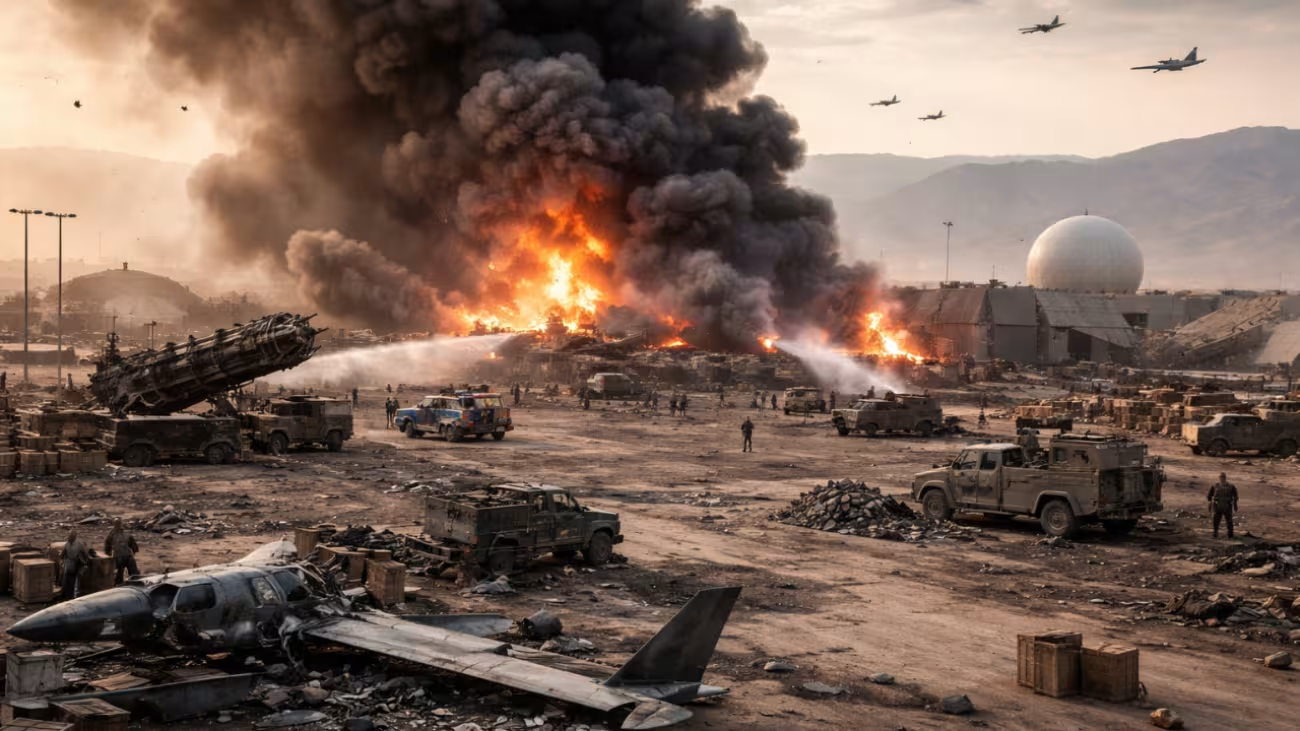
Iran's military strategy against the United States is entering a dangerous new phase. Following months of missile and drone exchanges, Tehran is reportedly preparing detailed retaliation plans targeting American military installations, critical infrastructure, and strategic communications networks across the Middle East.
A November 2026 Reuters investigation revealed that Iranian officials had disclosed the existence of detailed target lists prepared in anticipation of another US or Israeli military offensive. These reportedly include military bases, some covert facilities, and undersea communications cables.
The threat is no longer theoretical. An Associated Press investigation published in October found that Iranian missiles and drones had damaged or destroyed structures at 26 US military bases and other military sites across the Middle East.
On November 18, 2026, Iran again targeted US military installations in Kuwait while Bahrain reported intercepting additional Iranian attacks. These developments raise an important question: can American military bases in the Gulf remain secure if the confrontation escalates into another major war?
Iran's Secret Target List: What Is Tehran Planning?
According to a November 2 Reuters investigation, Iranian officials have prepared detailed lists of potential targets in the event of another US-Israeli military attack.
The reported plans extend beyond conventional military installations. They reportedly include:
- US military bases and facilities in Gulf countries.
- Covert military installations and communications facilities.
- Undersea telecommunications cables.
- Energy infrastructure and oil-related facilities.
- Water desalination plants.
- Communications networks and strategically important infrastructure.
The exact target lists have not been publicly released, and their complete contents have not been independently verified. Nevertheless, the Reuters reporting indicates that Tehran is preparing for retaliation that could affect both American military operations and the economic infrastructure of countries hosting US forces.
The strategy reflects a broader Iranian objective: increase the economic, military, and political costs of maintaining an American military presence in the region.
Why Iran Wants to Target US Military Bases
The United States maintains an extensive military presence across the Middle East, with installations supporting air operations, naval deployments, intelligence gathering, logistics, and regional security partnerships.
For Iran, these facilities represent strategic pressure points during a confrontation with Washington.
Tehran understands that it cannot match American military spending, air superiority, or conventional combat capabilities. Instead, Iran can use comparatively inexpensive drones, ballistic missiles, cruise missiles, and asymmetric warfare to challenge the security of American installations.
Reuters quoted Emile Hokayem of the International Institute for Strategic Studies, who described Iran's approach as an attrition strategy designed to make US forces increasingly expensive to defend and maintain.
In practical terms, Iran does not necessarily need to defeat the American military in a conventional battle. It can attempt to make the continued operation of US bases politically and economically difficult for Washington and its Gulf partners.
Which US Military Bases in the Middle East Are at Risk?
American installations across the Persian Gulf and neighboring countries have become increasingly exposed to Iranian missile and drone operations.
Several locations have already experienced attacks during the 2026 conflict.
1. Bahrain: Naval Support Activity Bahrain
Bahrain is one of the most important locations in America's regional military architecture because it hosts the headquarters of the US Navy's Fifth Fleet.
Naval Support Activity Bahrain supports naval operations, logistics, communications, and maritime security throughout the Persian Gulf and surrounding waters.
The installation has experienced significant damage during the conflict. Satellite imagery examined by the Associated Press showed damage to facilities and communications infrastructure.
Iran has also repeatedly targeted American facilities in Bahrain. On November 18, Bahraini authorities reported intercepting another series of Iranian attacks.
The location is particularly significant because disruptions to the Fifth Fleet's regional support infrastructure could complicate American naval operations.
2. Kuwait: Ali Al Salem Air Base
Ali Al Salem Air Base is an important American military installation in Kuwait, supporting aviation operations and regional deployments.
According to the Associated Press, the base experienced at least 30 Iranian strikes during the 2026 conflict, damaging or destroying aircraft hangars, warehouses, and other buildings.
On November 18, Iran again claimed to have targeted US drone and missile installations at Ali Al Salem.
Kuwaiti authorities confirmed that their air defenses had intercepted drone attacks but did not immediately report damage from the latest incident.
3. Kuwait: Camp Buehring
Camp Buehring is another important American military installation in Kuwait. It supports US Army operations and the movement of personnel and equipment throughout the region.
The Associated Press identified Camp Buehring as one of the most heavily damaged American military sites during the conflict.
Satellite imagery revealed substantial damage to multiple structures, including facilities used by military personnel.
The damage illustrates how relatively inexpensive drone attacks can create significant operational and financial consequences for a much larger military organization.
4. Qatar: Al Udeid Air Base
Al Udeid Air Base is one of the most strategically important American military facilities in the Middle East.
Located southwest of Doha, it supports US Central Command operations and serves as a major regional hub for air operations, logistics, and command functions.
Its importance makes the protection of its personnel, aircraft, communications, and supporting infrastructure a significant American security priority.
Qatar's position as a host country also means that any escalation involving the installation could have broader diplomatic and economic consequences.
5. Saudi Arabia: Prince Sultan Air Base
Prince Sultan Air Base supports American military operations in Saudi Arabia and has been associated with regional air defense and surveillance activities.
The Associated Press identified damage to radar infrastructure, aircraft, and other facilities during the 2026 conflict.
The damage demonstrates that Iranian attacks are not limited to bases located immediately along the Persian Gulf.
6. Jordan: Muwaffaq Salti Air Base
Muwaffaq Salti Air Base is an important installation for regional American and allied air operations.
It was among the locations affected by Iranian attacks on US military infrastructure. Satellite imagery examined by the Associated Press showed damage to radar and other facilities.
Jordan's geographic position makes it an important part of the regional military network connecting the Gulf, Iraq, Syria, and the eastern Mediterranean.
Iran's Most Dangerous Strategy: Destroying the Eyes of American Air Defense
One of the most important findings in the Associated Press investigation concerns the sequence of Iranian attacks.
Rather than concentrating exclusively on aircraft and buildings, Iran initially targeted systems designed to detect incoming missiles and drones.
These included early-warning radars and other air-defense infrastructure.
Such systems play a central role in identifying incoming threats and allowing defensive forces to respond before missiles or drones reach their intended destinations.
According to military analysts interviewed by the Associated Press, degrading these systems could reduce the effectiveness of regional air defense networks.
After attacking radar infrastructure, Iran expanded its strikes to other military facilities and equipment.
This pattern suggests that Tehran's approach was intended to impose broader operational disruption rather than simply destroy individual buildings.
Iran Used Social Media and Fitness Apps to Gather Intelligence
One of the most surprising revelations emerged in a November 14, 2026, investigation by the Los Angeles Times.
According to the report, Iranian military planners exploited publicly available information from social media accounts, fitness applications, online advertisements, and mapping services to understand activity patterns around American military installations.
These sources could reveal information about military personnel's routines, including exercise activities, movements, and general patterns of life around bases.
The report also described the use of satellite imagery reportedly supplied by Russia to improve Iran's understanding of American military locations and activities.
This combination of commercial data and satellite intelligence represents an important development in modern military surveillance.
Why Commercial Location Data Matters
Modern smartphones and applications can generate large quantities of location information.
When publicly available information is combined with commercially collected location data, analysts may be able to identify patterns that would otherwise require more sophisticated intelligence operations.
The Pentagon has responded by tightening digital security requirements for military personnel.
According to the Los Angeles Times, military branches have taken steps to restrict mobile advertising identifiers and limit the sharing of location information through personal devices.
The Navy has also issued guidance encouraging personnel to reduce unnecessary social media activity and disable location access where appropriate.
The broader lesson is that military security now extends beyond physical fences and traditional intelligence systems. Digital privacy has become an important element of protecting personnel and military installations.
How Powerful Are Iran's Missiles and Drones?
Iran has invested heavily in ballistic missiles, cruise missiles, and unmanned aerial vehicles.
These systems provide Tehran with the ability to threaten military installations and infrastructure across a substantial portion of the Middle East.
Although US and Israeli military operations have damaged Iranian production facilities and missile infrastructure, Iran has retained significant capabilities.
A Congressional Research Service assessment updated on October 20, 2026, cited a US Defense Intelligence Agency assessment that Iran retained thousands of missiles and one-way attack drones capable of threatening American and partner forces throughout the region.
The report also noted that Iran had been attempting to rebuild damaged military infrastructure and resume elements of missile production.
Ballistic Missiles
Ballistic missiles are among Iran's most significant conventional military capabilities.
They can threaten military facilities, infrastructure, and other strategic targets across the region.
Their effectiveness depends on several factors, including accuracy, payload, launch availability, and the ability of opposing forces to intercept incoming weapons.
Shahed-136 and Other Attack Drones
Iran's Shahed-series drones have attracted international attention because of their relatively low production costs and ability to conduct long-range attacks.
Unlike expensive conventional aircraft, one-way attack drones can be deployed in substantial numbers, potentially forcing defenders to use costly air-defense interceptors.
This creates an economic imbalance: an attacker may spend considerably less on an incoming drone than the defender spends attempting to intercept it.
Repeated attacks can therefore place pressure on defensive ammunition stocks, surveillance systems, and military budgets.
Can the United States Defend Its Bases Against Iranian Attacks?
The United States possesses some of the world's most advanced air-defense and military surveillance capabilities.
American forces and regional partners operate integrated systems designed to detect and intercept ballistic missiles, cruise missiles, and drones.
However, the 2026 conflict demonstrated that even advanced defenses cannot guarantee that every incoming weapon will be intercepted.
A November 14 Los Angeles Times investigation reported that the United States and its allies intercepted more than 90% of Iranian attacks during the period examined.
Despite that interception rate, the remaining attacks caused substantial damage to aircraft, radar systems, hangars, runways, and other facilities.
This highlights a critical military problem: defensive success is not determined solely by the percentage of incoming weapons intercepted. The consequences of the weapons that penetrate those defenses also matter.
The Financial Cost of Protecting American Military Bases
Iran's strategy also creates a significant economic challenge for Washington.
According to the Los Angeles Times, repairing damage to American military installations in the region could cost an estimated $9 billion, excluding damaged aircraft and other equipment.
The financial burden includes several categories:
- Repairing damaged military buildings and infrastructure.
- Replacing radar and communications equipment.
- Restoring aircraft hangars and operational facilities.
- Replacing damaged aircraft and military equipment.
- Expanding air-defense protection and surveillance capabilities.
- Relocating personnel and military assets when necessary.
These expenses illustrate why Iran's strategy of attrition could create significant pressure even without achieving conventional military superiority.
Could Iran Force the United States to Withdraw From the Middle East?
One of Tehran's broader strategic objectives appears to be reducing the American military presence in the region.
Reuters reported that regional security experts believe Iran wants to demonstrate that hosting American military bases can expose Gulf countries to retaliation rather than guarantee their security.
This creates a difficult political situation for governments such as Bahrain, Kuwait, Qatar, and Saudi Arabia.
These countries maintain important security relationships with Washington, but they also face the possibility of becoming targets during an American-Iranian confrontation.
Iran may therefore seek to create divisions between the United States and its regional partners by increasing the economic and security costs associated with hosting American forces.
However, forcing a complete US withdrawal would be difficult. American military partnerships, regional security commitments, and strategic interests remain substantial.
Latest Developments: Iran Attacks Kuwait and Bahrain on November 18, 2026
The security situation remains tense as of November 18, 2026.
According to Reuters and the Associated Press, Iran launched renewed attacks against American-linked military facilities in the Gulf.
The latest developments include:
- November 17: US fighter aircraft struck an Iranian Revolutionary Guard missile launch site on Qeshm Island in the Strait of Hormuz, according to a US military official.
- November 18: Iran said it targeted US drone and missile installations at Ali Al Salem Air Base in Kuwait.
- November 18: Kuwait reported intercepting hostile drone attacks.
- November 18: Bahrain reported intercepting additional Iranian aerial attacks, marking another incident within a week.
- November 18: Diplomatic efforts continued through Qatar, although negotiations remained difficult.
The United States described its November 17 strike as a defensive response to Iranian aggression against American personnel and assets.
These developments demonstrate that the confrontation remains active despite previous attempts to establish a more stable ceasefire.
What Happens if the Conflict Escalates Again?
A renewed large-scale confrontation could have consequences extending well beyond military installations.
Several developments would become increasingly important:
1. Greater Pressure on Gulf Countries
Countries hosting American forces could face additional security threats, potentially affecting civilian infrastructure, transportation, energy operations, and commercial activity.
2. Disruption to Oil and Gas Transportation
The Strait of Hormuz remains one of the world's most important energy transportation routes.
Any escalation involving shipping or maritime security could affect global oil and gas supplies, increasing energy prices and transportation costs.
3. Higher US Military Expenditure
Washington could be forced to spend more on missile defense, military relocation, infrastructure repairs, and regional deployments.
4. Greater Risk of a Wider Regional War
Iran's confrontation with the United States could involve additional regional actors, including Israel and Iran-aligned armed groups.
This would increase the possibility of simultaneous security crises across several Middle Eastern countries.
Final Thoughts: Are US Military Bases Really in Danger?
Yes. The danger is real, and the 2026 conflict has already demonstrated that American military installations across the Middle East are vulnerable to Iranian missile and drone attacks.
The most important development is not simply Iran's ability to launch missiles. It is the combination of asymmetric warfare, intelligence gathering, commercial location data, and attacks against critical military infrastructure.
Reuters reporting suggests that Tehran has prepared additional retaliation plans involving military installations and strategic infrastructure. Meanwhile, satellite imagery analyzed by the Associated Press confirms that previous attacks caused substantial damage to American military facilities.
Nevertheless, Iran has not demonstrated that it can defeat the United States in a conventional military confrontation. American air defenses, intelligence capabilities, naval forces, and regional partnerships remain powerful.
The real strategic challenge is whether Washington can continue maintaining its military presence at an acceptable financial and security cost.
Ultimately, Iran's approach appears focused on making American military operations increasingly expensive and politically difficult. If that strategy succeeds, its consequences could reshape the future of US military deployments throughout the Middle East.
- Log in to post comments