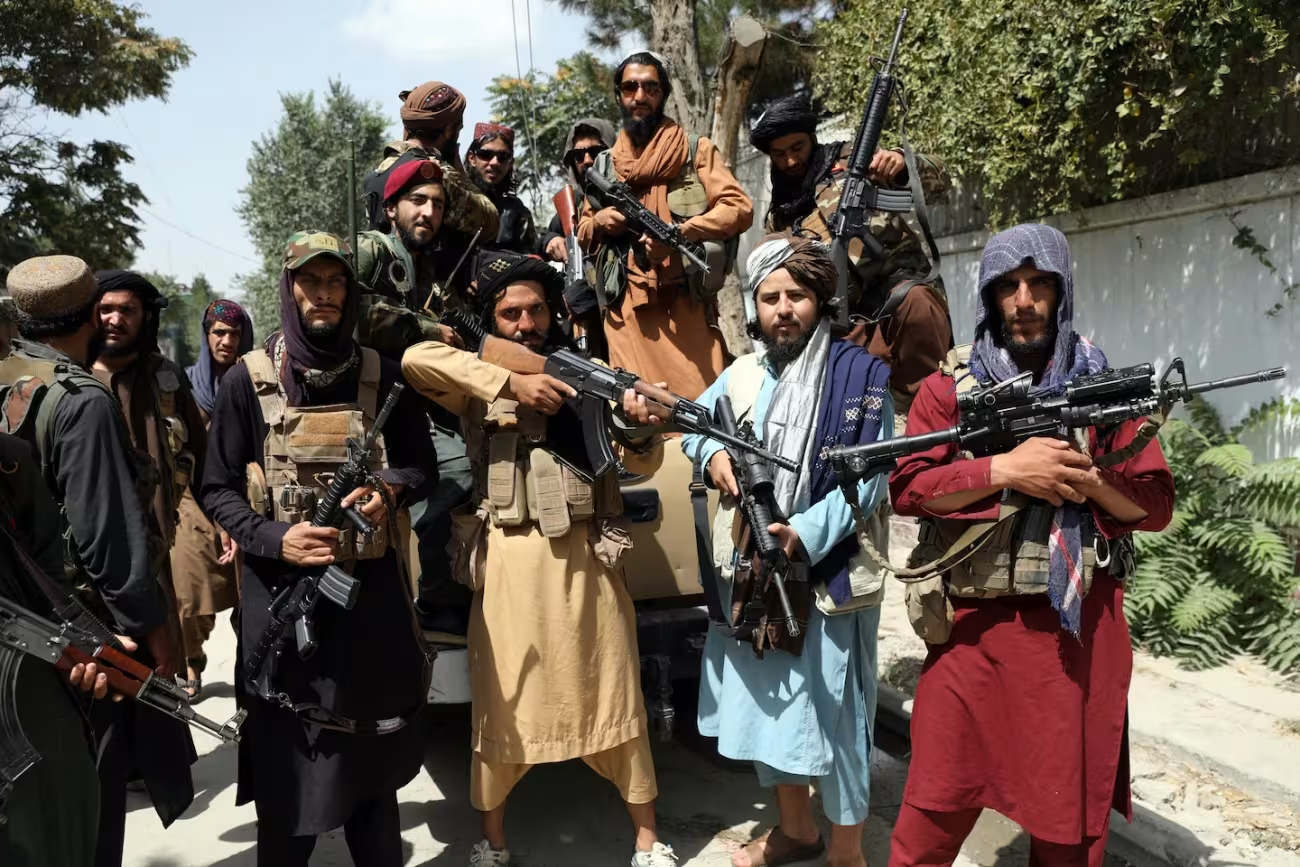
October 12, 2026. European governments that have condemned the Taliban for restricting women's rights are increasingly engaging with Afghanistan's rulers to arrange deportations. In June 2026, Taliban representatives met European Union officials in Brussels for discussions about returning Afghan nationals who no longer have permission to remain in Europe. The negotiations illustrate an emerging diplomatic relationship driven by migration policy, even as the Taliban face new international scrutiny over alleged crimes against humanity.
The situation presents a difficult political and legal challenge. European governments want to enforce immigration decisions and return people whose asylum applications have been rejected, while human rights organizations warn that deportees may face persecution, detention or abuse after arriving in Afghanistan.
For the Taliban, migration cooperation offers an opportunity to negotiate directly with governments that have largely refused to recognize their administration since they regained power in August 2021.
The debate has intensified as several European countries strengthen deportation policies. It also raises broader questions about the Taliban's interpretation of Sharia law, the treatment of women and children, the leadership governing Afghanistan and the international community's responsibility toward people fleeing persecution.
Why Are European Governments Negotiating With the Taliban?
European governments face continuing pressure to control irregular migration and implement deportation decisions. Afghanistan remains an important country of origin for asylum seekers, particularly because of insecurity, economic hardship and the restrictions imposed under Taliban rule.
Returning people to Afghanistan presents practical difficulties because many European governments do not formally recognize the Taliban administration and have limited diplomatic relations with Kabul.
Deportations often require cooperation from authorities in the receiving country, including identity verification, travel documentation and arrangements for admitting returning nationals.
This creates a situation in which European countries seeking to enforce immigration decisions may need assistance from the same authorities they criticize for serious human rights violations.
The June 23, 2026 Brussels Meeting
On June 23, 2026, Taliban representatives held closed-door discussions in Brussels with officials from the European Commission and 15 European Union member states.
The meeting focused on diplomatic services and arrangements for returning Afghan nationals without permission to remain in Europe.
According to reporting by Associated Press and Euronews, the discussions involved practical measures intended to make returns more efficient.
The meeting followed earlier technical engagement between European officials and Taliban representatives in Afghanistan.
For the Taliban, the Brussels gathering represented an opportunity to establish direct contact with European institutions despite the absence of formal diplomatic recognition.
European officials have distinguished such technical discussions from political endorsement of the Taliban government.
Nevertheless, Afghan civil society organizations criticized the meeting, arguing that cooperation on deportations could gradually normalize relations without corresponding improvements in human rights.
How Many Afghan Refugees Are Seeking Protection in Europe?
Afghans remain among the largest groups seeking international protection in Europe, although the number of applications varies depending on the statistical definition and countries included.
According to Eurostat, the European Union recorded approximately 669,400 first-time asylum applications in 2025, a decline of 27% from 2024.
Afghan nationals submitted about 63,800 of those applications, representing approximately 10% of the total.
Only Venezuelan nationals submitted more first-time applications during that period.
European Union Asylum Statistics
| Indicator | Reported Figure | Period |
|---|---|---|
| First-time asylum applications in the EU | 669,400 | 2025 |
| First-time applications by Afghans | 63,800 | 2025 |
| Afghan share of EU first-time applications | Approximately 10% | 2025 |
| Afghan asylum applications in EU+ countries | Approximately 39,000 | January–June 2026 |
| Change in Afghan EU+ applications | 7% decrease year over year | First half of 2026 |
The 2025 EU figures measure first-time applications in European Union member states. The 2026 EU+ figure covers a wider group of European countries and includes applications under a different statistical framework.
These numbers should not be directly compared as though they measure identical populations.
The European Union Agency for Asylum also reported that applications from Afghan nationals increased during 2025 partly because women already living in Europe sought stronger forms of international protection following legal developments concerning gender-based persecution.
Germany's Expanding Deportations to Afghanistan
Germany has been among the European countries pursuing more direct arrangements for deporting Afghan nationals.
After the Taliban returned to power in 2021, Germany suspended deportations to Afghanistan because of security and human rights concerns.
Returns subsequently resumed in limited circumstances, initially focusing on individuals convicted of crimes.
In July 2025, Germany deported 81 Afghan men whom Interior Minister Alexander Dobrindt described as convicted criminals.
By 2026, the government's approach had broadened.
July 28, 2026: Deportation of an Afghan Without a Criminal Record
On July 28, Germany deported 31 Afghan men, including one individual without a criminal conviction.
According to Reuters, German authorities said the man had exhausted his asylum claim and was legally required to leave the country.
The other 30 deportees had criminal convictions.
The operation marked an important development because Germany had previously concentrated post-2021 deportations on people convicted of crimes.
Supporters of the policy argue that governments must be able to enforce final immigration decisions, including when applicants have no legal basis to remain.
Critics argue that the general human rights situation in Afghanistan requires particularly careful assessment of the risks facing each deportee.
A rejected asylum application does not necessarily establish that a person will be safe upon return, especially when circumstances in the country of origin change.
Can Deportations Give the Taliban Greater Political Influence?
The Taliban have sought greater international engagement since returning to power in August 2021.
Direct negotiations with European governments could provide practical and diplomatic advantages, including more regular official contacts and discussions about consular cooperation.
Such engagement may also allow Taliban representatives to present themselves as indispensable partners in migration management.
However, technical cooperation does not automatically amount to formal recognition of Afghanistan's Taliban administration.
European governments can negotiate specific operational arrangements while continuing to criticize the Taliban's human rights practices.
The political concern expressed by rights organizations is that repeated engagement could increase the Taliban's international standing without producing improvements in protections for women, journalists, minorities and political opponents.
Whether migration negotiations lead to broader diplomatic concessions depends on the terms of individual agreements and subsequent government decisions.
Who Is the Taliban Leader in 2026?
The Taliban's supreme leader is Hibatullah Akhundzada, also commonly spelled Haibatullah Akhundzada.
He has led the movement since 2016 and remained its highest authority after the Taliban returned to power in August 2021.
Akhundzada exercises considerable influence over the government's religious and political direction, including decisions involving education, social conduct and the legal system.
He operates primarily from Kandahar rather than maintaining a highly visible public presence in Kabul.
Key Taliban Leaders and Officials
| Official | Position | Role |
|---|---|---|
| Hibatullah Akhundzada | Supreme Leader | Highest religious and political authority |
| Mohammad Hassan Akhund | Acting Prime Minister | Oversees the administration |
| Sirajuddin Haqqani | Acting Interior Minister | Internal security and policing |
| Amir Khan Muttaqi | Acting Foreign Minister | Foreign relations and diplomatic engagement |
| Abdul Hakim Haqqani | Chief Justice | Judicial leadership |
The Taliban refer to their state as the Islamic Emirate of Afghanistan. Their governing system concentrates power in religious leadership rather than operating through the electoral institutions established under Afghanistan's former republic.
International Criminal Court Warrants Against Taliban Leaders
On October 5, 2026, the International Criminal Court released additional details about arrest warrants issued for four senior Taliban figures.
Those named included Supreme Leader Hibatullah Akhundzada, Chief Justice Abdul Hakim Haqqani, Education Minister Habibullah Agha and Higher Education Minister Neda Mohammad Nadim.
The warrants concern allegations of crimes against humanity involving persecution on gender grounds.
ICC judges identified alleged policies targeting women, girls and people who do not conform to Taliban-imposed gender norms.
The allegations include serious violations associated with restrictions on education, freedom of movement, employment and public participation.
The issuance of an arrest warrant does not establish criminal guilt. The allegations would need to be determined through the relevant judicial process.
Taliban representatives have rejected the ICC's authority and maintain that their government acts according to Islamic law.
What Is Sharia Law, and How Does the Taliban Interpret It?
Sharia refers broadly to Islamic religious and ethical principles derived from the Quran, the teachings of the Prophet Muhammad and traditions of Islamic legal interpretation.
It encompasses subjects ranging from worship and family relations to commerce, personal conduct and legal responsibilities.
Sharia is not a single universally codified law applied identically across Muslim societies. Its interpretation varies among Islamic legal schools, scholars and national legal systems.
The Taliban's system draws heavily on a strict interpretation associated with the Deobandi Sunni tradition, combined with the movement's own political and social rules.
Its implementation has attracted criticism because of restrictions on women, harsh punishments and limitations on individual freedoms.
It would be inaccurate, however, to portray the Taliban's interpretation as representative of all Muslims or all countries incorporating aspects of Islamic law.
Sharia-Based Restrictions Under Taliban Rule
Since August 2021, the Taliban have imposed measures affecting many aspects of daily life.
- Girls are barred from formal secondary education beyond the sixth grade.
- Women are prohibited from attending universities.
- Women's employment opportunities are heavily restricted in numerous sectors.
- Dress codes and requirements involving male guardians limit freedom of movement.
- Public corporal punishments, including flogging, have been carried out.
- Independent media and political expression face extensive restrictions.
The Taliban justify their policies through their interpretation of Islamic principles and Afghan social traditions.
International human rights organizations argue that many of these measures violate Afghanistan's legal obligations and discriminate against women and girls.
Women's Rights in Afghanistan: New Arrests in October 2026
The situation facing Afghan women remains a major concern for organizations assessing the safety of returning refugees.
On October 8, 2026, the United Nations Assistance Mission in Afghanistan reported that at least 52 women and one girl had been arrested or detained between July and September in Kabul and Herat.
The arrests involved alleged violations of Taliban dress requirements, including visible hair, colorful scarves, makeup or appearing in public without a male guardian.
UNAMA also documented reports of verbal abuse, beatings and threats against women, including female shopkeepers.
The mission warned that the actual number of incidents could be higher because victims may be reluctant to report abuses.
The incidents illustrate the risks facing women whose appearance, employment or everyday conduct is judged to violate Taliban regulations.
Malala Yousafzai and the Taliban's Restrictions on Girls' Education
Malala Yousafzai is a Pakistani education activist and Nobel Peace Prize laureate who became internationally known after surviving a Taliban attack in 2012.
She was born in Mingora, in Pakistan's Swat Valley, and began advocating publicly for girls' education while still a child.
On October 9, 2012, a gunman associated with the Pakistani Taliban attacked her school bus, seriously injuring her.
Malala survived and continued campaigning internationally for girls' access to education.
In 2014, she became the youngest recipient of the Nobel Peace Prize.
Are the Pakistani Taliban and Afghan Taliban the Same?
No. The Pakistani Taliban, commonly called Tehrik-i-Taliban Pakistan or TTP, is a distinct militant organization from the Afghan Taliban.
The groups have historical and ideological connections, but they have different organizational structures, leadership and political objectives.
The TTP was responsible for the attack on Malala, not an operation publicly established as having been ordered by the current Taliban government in Afghanistan.
This distinction is important when discussing Malala's history alongside present-day conditions in Afghanistan.
Malala's Response to Taliban Policies in 2026
Malala and the Malala Fund continue advocating for Afghan girls who have been excluded from secondary schools and universities.
In February 2026, the Malala Fund criticized the Taliban's new criminal procedure code, arguing that it intensified restrictions on women's autonomy and weakened protections against abuse.
The organization has called for international accountability and stronger protection of girls' education.
Malala's advocacy is especially relevant to deportation discussions because Afghan girls returning from Europe may face educational restrictions that differ substantially from those available in their host countries.
What Is Bacha Bazi in Afghanistan?
Bacha bazi is a term associated with the sexual exploitation of boys in Afghanistan.
The practice has historically involved powerful adult men exploiting underage boys, sometimes forcing them to perform dances or provide sexual services.
It is a form of child abuse and exploitation, not a legitimate cultural entitlement or an accepted religious requirement.
Bacha bazi existed before the Taliban returned to power and has been documented under different Afghan governments.
The Taliban have formally prohibited the practice in some of their legal regulations. However, human rights reporting continues to document allegations of sexual exploitation and trafficking involving boys.
Is Bacha Bazi Still Happening Under the Taliban?
Available evidence indicates that bacha bazi has not disappeared.
A May 2026 United Kingdom government country-information assessment noted reports of continuing sexual exploitation of boys, including cases associated with influential local figures, armed groups and Taliban members.
The assessment cited the U.S. State Department's 2025 Trafficking in Persons Report, which described patterns of child sexual exploitation and significant obstacles to identifying victims.
Victims may face intimidation, social stigma and limited access to legal protection.
Reports also indicate that some children subjected to exploitation fear punishment if they disclose what happened.
These findings do not establish that every Taliban official participates in the practice. They demonstrate serious weaknesses in victim protection and concerns about accountability.
How Taliban Laws Address Child Exploitation
UNAMA previously identified provisions in Taliban regulations prohibiting bacha bazi and the mistreatment of orphans as positive measures.
However, formal prohibitions are different from effective enforcement.
Human rights organizations continue to question whether vulnerable children can safely report abuse and whether powerful perpetrators face meaningful investigation.
Georgetown University's Institute for Women, Peace and Security also raised concerns in July 2026 about provisions in the Taliban's newer legal framework that could weaken protections for children and women.
What Risks Could Afghan Deportees Face?
Afghanistan's human rights conditions create serious challenges when European authorities consider forced returns.
Risks vary according to individual circumstances, including gender, age, ethnicity, religious identity, political history and previous association with international organizations or the former Afghan government.
People who publicly opposed the Taliban may face different dangers from those who have no documented political involvement.
Women and Girls
Female returnees face restrictions on education, work and freedom of movement.
Women without a reliable family support network may encounter additional barriers involving accommodation, employment and access to medical services.
Former Government Personnel
Human rights organizations continue documenting allegations of arbitrary detention, disappearances and mistreatment involving people associated with Afghanistan's former security forces and institutions.
Religious and Ethnic Minorities
Members of some minority communities face security concerns, discrimination and threats from armed extremist organizations, including Islamic State Khorasan Province.
The nature of these risks differs between communities and locations.
Unaccompanied Children
Children returning without reliable family support may be vulnerable to trafficking, forced labor, sexual exploitation and difficulties accessing education or health care.
The United Kingdom's May 2026 country guidance stated that internal relocation is generally unlikely to be reasonable for an unaccompanied Afghan child with no family to return to.
What Does International Law Say About Deporting Refugees?
International refugee law recognizes the principle of non-refoulement, which prohibits returning a person to a country where they would face certain serious threats, including persecution.
Protections also arise under international human rights law, including rules against returning people to a substantial risk of torture or inhuman treatment.
These obligations require authorities to evaluate relevant risks rather than assuming that every rejected asylum applicant can safely be deported.
At the same time, international law does not prohibit all deportations to Afghanistan in every possible circumstance.
Governments may seek to return people who lack legal permission to remain, provided the decision complies with applicable refugee, human rights and procedural protections.
The central legal question is whether an individual return would expose the person to a prohibited risk.
Why Human Rights Groups Oppose Broader Deportation Cooperation
Human Rights Watch has urged governments to suspend forced returns to Afghanistan because of the Taliban's repression and the country's humanitarian conditions.
In August 2026, the organization estimated that nearly 40% of Afghanistan's population required urgent humanitarian assistance.
Humanitarian difficulties have been intensified by reduced foreign aid and large-scale returns from neighboring countries.
After the Brussels deportation talks, more than 40 Afghan and international civil society organizations signed a joint letter expressing concern that migration cooperation could normalize relations with the Taliban.
The signatories called for compliance with international protection obligations and warned about the consequences of returning vulnerable people.
European governments, meanwhile, maintain that immigration systems require enforceable rules and procedures for returning people who have no right to remain.
The unresolved issue is how to reconcile those administrative objectives with the specific dangers documented in Afghanistan.
Europe's New Migration Rules in October 2026
The European Union has continued strengthening its migration and return policies.
On October 1, 2026, EU home affairs ministers discussed cooperation with non-EU countries on readmission and measures intended to improve the management of migration flows.
The Council also adopted new rules concerning returns of people who do not have permission to remain in the European Union.
Officials emphasized more effective cooperation with countries of origin and improved information sharing among member states.
The discussions reflect a broader policy shift toward increased enforcement of return decisions.
However, general migration rules do not automatically settle the question of whether returning a particular Afghan national would comply with human rights obligations.
Timeline: Taliban Rule and Europe's Deportation Policy
| Date | Development |
|---|---|
| August 15, 2021 | Taliban forces capture Kabul and return to power in Afghanistan. |
| August 2024 | Germany resumes limited deportations to Afghanistan after a suspension following the Taliban takeover. |
| July 18, 2025 | Germany deports 81 Afghan men with criminal convictions. |
| June 23, 2026 | Taliban representatives meet European officials in Brussels to discuss Afghan returns. |
| June 24, 2026 | Afghan and international civil society organizations criticize the EU's engagement over deportations. |
| July 28, 2026 | Germany deports 31 Afghan men, including one without a criminal record. |
| October 1, 2026 | EU ministers discuss stronger readmission cooperation and adopt new return rules. |
| October 5, 2026 | ICC releases details of arrest warrants involving four senior Taliban figures. |
| October 8, 2026 | UNAMA reports at least 53 women and girls detained for alleged dress code violations during July–September. |
| October 12, 2026 | New reporting highlights Europe's growing dependence on Taliban cooperation for Afghan deportations. |
Could Deportation Agreements Lead to Recognition of the Taliban?
Cooperation on immigration matters does not automatically create diplomatic recognition.
Governments frequently maintain practical contacts with authorities they do not formally recognize, particularly when necessary to address humanitarian, security or consular matters.
However, sustained negotiations may increase the Taliban's practical ability to participate in international discussions.
The Taliban may view this as evidence that foreign governments must engage with their administration regardless of disagreements over human rights.
European governments, by contrast, describe migration negotiations as administrative steps rather than political endorsement.
The significance of the relationship will depend on whether cooperation remains limited to specific technical matters or develops into broader diplomatic arrangements.
Frequently Asked Questions
Why is Europe negotiating with the Taliban?
European governments are seeking arrangements that would allow them to return Afghan nationals whose asylum claims have been rejected or who otherwise lack legal permission to remain.
Does the European Union recognize the Taliban government?
Technical engagement on deportations does not amount to formal diplomatic recognition. European institutions continue to express concern about the Taliban's human rights practices.
Who is the Taliban leader in 2026?
Hibatullah Akhundzada remains the Taliban's supreme leader. He is one of the senior figures named in International Criminal Court warrants involving allegations of gender persecution.
What Sharia law does the Taliban follow?
The Taliban applies its own strict interpretation of Sunni Islamic legal traditions, influenced by Deobandi teachings. This interpretation differs from the diverse legal approaches found throughout the Muslim world.
Is bacha bazi legal under the Taliban?
The Taliban has formally prohibited bacha bazi in some regulations, but human rights reports continue to document child sexual exploitation and concerns about weak enforcement and victim protection.
Was Malala Yousafzai attacked by the Afghan Taliban?
Malala was attacked in Pakistan in October 2012 by a gunman associated with the Pakistani Taliban, or TTP, a separate organization from the Afghan Taliban.
Can Afghan refugees legally be deported from Europe?
Some deportations may be lawful, but authorities must respect applicable refugee and human rights protections. Individuals cannot lawfully be returned where prohibited risks of persecution or serious mistreatment are established.
How many Afghans sought asylum in Europe in 2025?
Eurostat recorded approximately 63,800 first-time asylum applications by Afghan nationals in European Union countries during 2025.
Conclusion
The Taliban's growing engagement with European governments over migration reflects an increasingly difficult intersection of domestic immigration policy and international human rights concerns.
European authorities want more effective systems for returning people who have no legal right to remain. The Taliban, meanwhile, can use its role in accepting deportees to secure direct communication with governments that continue to criticize its administration.
The June 2026 Brussels meeting and Germany's subsequent deportations demonstrate that this cooperation is no longer purely theoretical.
At the same time, Afghanistan remains subject to severe restrictions on women's rights, allegations of persecution and extensive humanitarian needs. Recent United Nations findings and International Criminal Court proceedings underscore the continuing seriousness of those concerns.
The key challenge is whether European governments can enforce lawful immigration decisions without exposing individuals to prohibited risks or weakening their stated commitments to human rights.
As of October 2026, the diplomatic relationship between Europe and the Taliban remains limited and contested, but migration negotiations have made the authorities in Kabul increasingly difficult for European policymakers to avoid.
- Log in to post comments