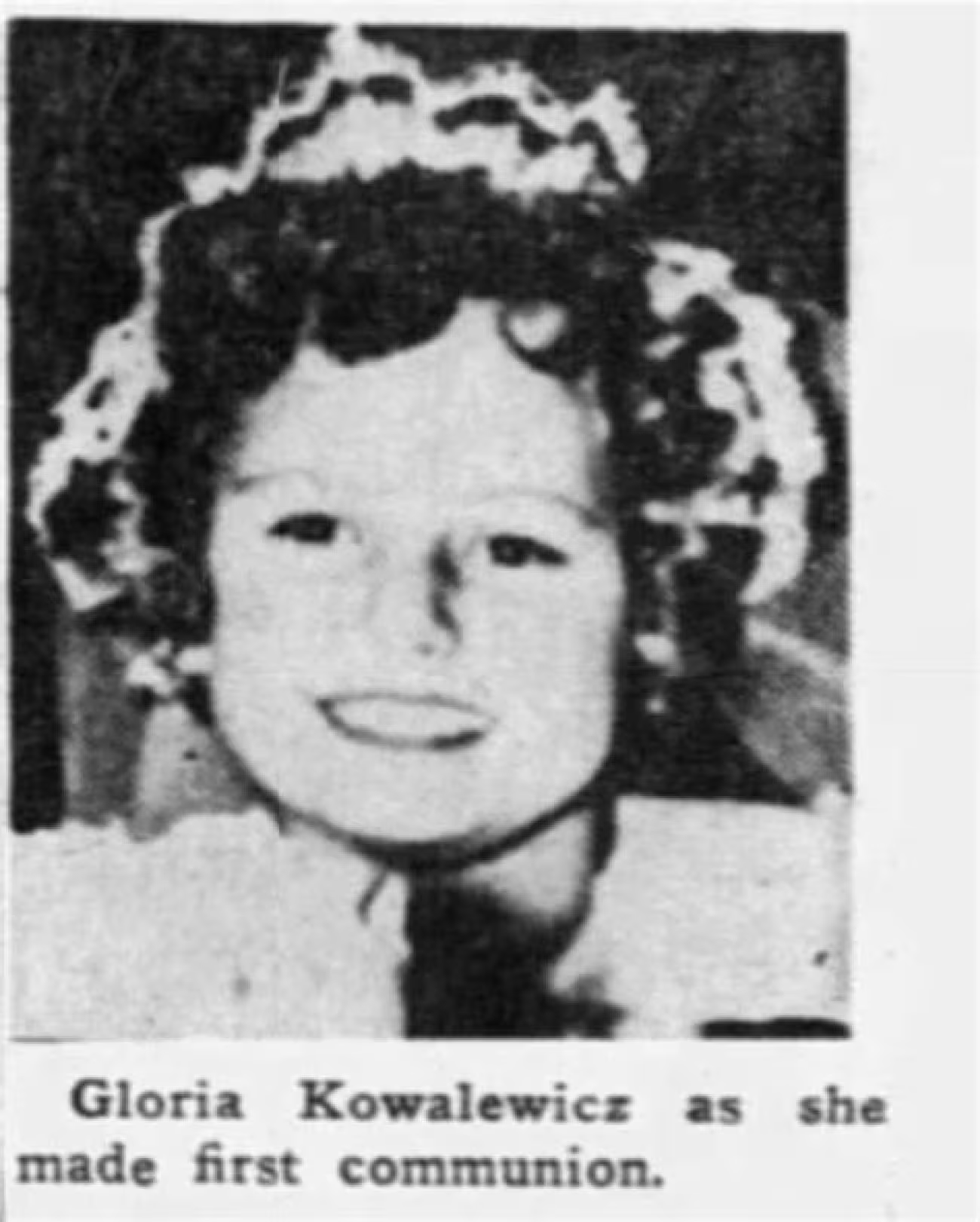
October 12, 2026. Chicago police say they have identified the suspected killer of Gloria Kowalewicz, an eight-year-old girl murdered on November 12, 1960, while walking to church in Chicago. Nearly 66 years later, investigators have linked her death to Thomas Francis McInerney, a former Chicago police officer who later worked as a homicide detective. The identification followed advances in forensic genetic genealogy, DNA analysis and fingerprint comparisons using evidence preserved from the original investigation.
McInerney was 24 years old when Gloria disappeared from Chicago's West Englewood neighborhood. He remained with the Chicago Police Department until 1987, serving in several investigative assignments, including homicide and sex crimes. He died in Las Vegas in 2006 without ever being charged in connection with Gloria's death.
The breakthrough was reported by the Chicago Tribune on October 11, 2026, after investigators established a DNA connection and matched a fingerprint recovered from Gloria's purse to McInerney's original police employment records. Chicago police consider the case solved, although the suspect's death means the evidence will never be tested in a criminal trial.
What Happened to Gloria Kowalewicz on November 12, 1960?
Gloria lived with her parents, Edward and Esther Kowalewicz, and her younger brother in Chicago's West Englewood neighborhood.
She attended St. Mary of Mount Carmel School and had recently received her First Holy Communion. A nun had encouraged Gloria and her classmates to attend Communion regularly for two weeks.
Saturday, November 12, was the final day of that religious observance.
Gloria's father needed the family car that morning, so her mother prepared her to make the short journey to church on foot.
Esther dressed her daughter in a pink-and-brown checkered dress and a blue leotard. She watched Gloria leave the family home and walk north along Damen Avenue before turning east onto Marquette Road.
The church was only about three and a half blocks away.
Gloria never arrived.
Her Body Was Found Hours Later in Palos Park
Shortly before noon, a laundry company driver stopped near a wooded area in Palos Park, more than 15 miles southwest of Gloria's home.
While reviewing his delivery route, the driver noticed something brightly colored in a ravine beside the road.
It was Gloria's dress.
He approached and discovered the child's body. After finding no signs of life, he contacted authorities through a nearby business.
Investigators determined that Gloria had been shot twice in the head. They also documented bruising around her neck.
Evidence at the scene suggested that she had been brought to the wooded location before being killed.
The distance between her home and the location of her body indicated that she had been transported away from her neighborhood.
What Evidence Did Police Find at the Murder Scene?
The original investigation involved Chicago police, Cook County sheriff's investigators and Illinois State Police.
Officers examined the wooded area, collected physical evidence and searched nearby waterways.
Among the items recovered were Gloria's clothing, shoes, purse and Bible.
Police also documented tire impressions and recovered firearms-related evidence.
Fingerprints were collected from the strap of Gloria's purse and from her Bible.
At the time, investigators had no practical way to compare biological material using modern DNA profiling techniques, which would not become widely available in criminal investigations until decades later.
The preservation of physical evidence eventually became essential to solving the case.
Why Was Biological Evidence Important?
During renewed forensic examinations, investigators identified male biological material associated with Gloria's clothing.
The discovery allowed specialists to develop a DNA profile that could be compared with investigative databases.
Although police initially believed Gloria had not been sexually assaulted, the later discovery of semen changed the evidentiary picture. The available reports do not establish every circumstance of the biological evidence or independently prove the complete sequence of events.
What matters for the identification is that the DNA ultimately connected the evidence to McInerney.
The Massive 1960 Investigation That Failed to Identify a Killer
Gloria's murder shocked Chicago and triggered a large investigation.
Police canvassed the West Englewood neighborhood, interviewed residents and examined possible suspects.
Firefighters, military veterans, Boy Scouts and other community volunteers assisted with the search and investigative efforts.
More than 1,300 people were interviewed during the initial investigation.
Authorities also questioned individuals previously associated with crimes involving children, but the investigation did not produce sufficient evidence to charge anyone.
Witnesses Reported Seeing a Girl With a Man
Several witnesses told investigators they had seen a girl resembling Gloria with an adult man after she left home.
Descriptions suggested a man approximately 25 to 40 years old.
However, those observations did not lead to a reliable identification at the time.
The investigation eventually lost momentum despite extensive public attention.
For decades, Gloria's family was left without an answer about who had killed her.
Who Was Thomas Francis McInerney?
Thomas Francis McInerney was a former Chicago police officer and United States Army veteran who spent approximately 28 years with the Chicago Police Department.
He joined the department in 1959, one year before Gloria's murder.
At the time of the crime, McInerney was 24 years old and had family connections to the area near the Kowalewicz household.
His parents lived approximately three-quarters of a mile from Gloria's home. His father worked in corrections.
Investigators reported that McInerney had no known previous contact with Gloria.
Thomas Francis McInerney's Police Career
| Period | Career Development |
|---|---|
| 1959 | Joined the Chicago Police Department |
| 1960 | Serving as a police officer when Gloria Kowalewicz was murdered |
| 1964 | Promoted to detective |
| 1960s–1980s | Worked assignments involving burglary, vice, gangs, homicide, sex crimes and violent crime |
| 1987 | Retired from the Chicago Police Department |
| After leaving Chicago | Worked as an investigator for the Federal Public Defender's Office in Nevada |
| 2004 | Retired from his federal investigative work |
| 2006 | Died in Las Vegas |
His subsequent career included investigative work in Las Vegas and Reno.
According to obituary information cited in contemporary reporting, McInerney received an Outstanding Federal Defender Investigator award in 2003.
He was also a father and grandfather.
The revelation that a career police officer was the suspected killer created particular concern because he had spent decades in positions involving criminal investigations and public trust.
How DNA Evidence Reopened the Gloria Kowalewicz Cold Case
The forensic breakthrough developed gradually rather than through one isolated test.
Investigators preserved evidence from the original crime scene and revisited it as laboratory technology improved.
2010: Investigators Obtain a Male DNA Profile
In July 2010, Chicago police used grant funding to submit Gloria's dress for forensic DNA analysis.
Approximately five months later, laboratory testing identified a male DNA profile from semen recovered on the clothing.
Investigators submitted the profile to the FBI's Combined DNA Index System, known as CODIS.
The database searches generated potential investigative leads.
However, subsequent testing ruled out the individuals examined during that phase of the investigation.
The case remained unresolved for another 14 years.
2024: The FBI Begins Investigative Genetic Genealogy
In 2024, Chicago police submitted Gloria's coat to the FBI for further forensic work using funding associated with a sexual assault kit initiative.
The investigators used a technique known as investigative genetic genealogy.
Unlike a conventional law enforcement DNA database search, genetic genealogy can identify potential relatives of an unknown DNA contributor through genetic matches and family-tree research.
Investigators then combine the genetic information with public records and conventional detective work to narrow a list of potential suspects.
The method has become increasingly important in cold cases where crime-scene DNA does not produce a direct match in standard law enforcement databases.
July 2026: Thomas McInerney Is Identified
According to Chicago Police Department Lieutenant Mark Kearns, investigators positively identified McInerney in July 2026 as the donor of the semen recovered from Gloria's dress.
The finding was central to the department's conclusion that he was responsible for the killing.
Investigators then examined additional evidence preserved from the original case.
That evidence provided a separate link to McInerney.
The Fingerprint Match That Strengthened the Case
After identifying McInerney through forensic DNA work, investigators retrieved his original 1959 Chicago Police Department employment application.
The application contained fingerprints submitted when he joined the department.
Police compared those prints with fingerprints recovered from Gloria's purse strap in 1960.
Investigators reported a match.
This mattered because the fingerprint was recovered from an item directly associated with Gloria, providing physical evidence separate from the genetic-genealogy investigation.
The fingerprints also connected a record preserved by the police department with evidence collected from a crime that remained unresolved throughout McInerney's career.
What Did Ballistics Evidence Show?
Police also examined firearms-related evidence from the original investigation.
Investigators determined that McInerney owned three Colt revolvers of a type consistent with the firearm evidence in Gloria's killing.
However, the reports reviewed do not establish that police recovered the specific murder weapon or matched an individual firearm to the fatal shooting.
The firearms information therefore provides supporting context, but it should not be described as a definitive individual gun identification.
Why Was McInerney Never Arrested?
McInerney was not publicly identified as a suspect during his lifetime.
The evidence connecting him to Gloria's murder was developed years after he died.
He retired from the Chicago Police Department in 1987 and moved to Nevada, where he continued working as an investigator.
He died in Las Vegas in 2006.
By the time detectives reached their conclusion in 2026, prosecution was no longer possible.
Although police regard the investigation as resolved, there will be no criminal trial or conviction establishing his guilt in court.
The distinction matters because a police identification can provide an investigative resolution without producing a judicial determination.
Did McInerney Investigate Gloria's Murder Himself?
The available reporting does not establish that McInerney personally investigated Gloria's homicide in 1960.
He was a relatively new police officer at the time and did not become a detective until 1964.
His later assignments included homicide investigations, but that does not mean he participated in the original investigation into Gloria's death.
Likewise, investigators have not reported evidence that he deliberately interfered with the original case or used his police position to conceal specific evidence.
Those possibilities should not be presented as established facts.
The verified concern is that the person police now identify as their suspect remained employed in law enforcement for decades after the murder.
Was Thomas Francis McInerney Linked to Other Murders?
Chicago police have said McInerney is not currently suspected in other crimes.
Investigators also reported that they found no evidence of prior contact between McInerney and Gloria.
His work as a homicide and sex-crimes detective has understandably drawn scrutiny, but that professional history alone does not establish involvement in additional offenses.
No confirmed evidence available through October 12, 2026, identifies him as a serial killer.
The motive behind Gloria's abduction and murder also remains unknown.
What Is Investigative Genetic Genealogy?
Investigative genetic genealogy combines modern DNA testing with genealogical research to help identify an unknown person connected to crime-scene evidence.
The method differs from ordinary DNA matching used in systems such as CODIS.
How the Process Works
- DNA extraction: A laboratory obtains genetic material from preserved crime-scene evidence.
- Profile development: Scientists generate genetic information suitable for comparison with reference data.
- Relative matching: Investigators identify potential biological relatives through participating genealogy databases.
- Family-tree research: Genealogists examine public records to trace relationships and narrow potential candidates.
- Investigative verification: Detectives compare promising leads with age, location, physical evidence and other case information.
- Confirmation: Additional forensic testing may provide a stronger identification of the DNA contributor.
The technique does not mean investigators automatically obtain every user's genetic information from commercial ancestry services.
Database participation, law enforcement access and consent policies vary among platforms.
The particular genealogy website used during the Kowalewicz investigation was not identified in the reporting reviewed.
How Genetic Genealogy Has Changed Cold Case Investigations
Forensic genetic genealogy became widely known following the identification of Joseph James DeAngelo as the Golden State Killer in 2018.
DeAngelo, a former California police officer, was linked to a series of murders and sexual assaults committed during the 1970s and 1980s.
He later pleaded guilty and received multiple life sentences.
Since then, law enforcement agencies have used similar techniques to investigate unresolved homicides, sexual assaults and unidentified human remains.
The approach is particularly useful when conventional database searches have failed but investigators still possess usable biological evidence.
At the same time, its use raises privacy questions about genetic information, consent and how law enforcement can access data supplied for family-history research.
The Kowalewicz case shows how older physical evidence can acquire new investigative value as forensic technology develops.
How Gloria's Family Responded to the 2026 Breakthrough
For Gloria's surviving relatives, the identification brought answers after nearly 66 years.
Her younger brother, Adam Kowalewicz, was an infant when she was murdered.
In an October 2026 interview with the Chicago Tribune, Adam described the emotional impact of learning that investigators had identified a suspect.
He also expressed shock that the man police connected to the killing had been a Chicago police officer.
His father, Edward, died in 1978, while his mother, Esther, died in 2000.
Neither parent lived long enough to learn the outcome of the investigation.
Adam said he was grateful to the detectives who continued working on the case, but he also expressed frustration that McInerney had died without facing criminal accountability.
The family's remaining question concerns motive: why Gloria was targeted during an ordinary walk to church.
Chicago Police Respond to the Identification
Chicago Police Department Chief of Detectives Kevin Bruno described the revelation that a police officer was the suspected killer as deeply troubling.
He also emphasized the persistence of investigators who continued reviewing evidence across multiple generations of forensic technology.
Bruno said the department did not intend to minimize the significance of McInerney's law enforcement career.
The department's conclusion reflects the combination of DNA identification, fingerprints and other preserved evidence.
Police consider the homicide resolved, although the lack of a living suspect prevents a prosecution.
Gloria Kowalewicz Cold Case Timeline
| Date | Development |
|---|---|
| 1959 | Thomas Francis McInerney joins the Chicago Police Department. |
| November 12, 1960 | Gloria Kowalewicz disappears while walking to church and is found murdered in Palos Park. |
| November 16, 1960 | More than 1,000 people attend Gloria's funeral. |
| 1964 | McInerney is promoted to detective. |
| 1987 | McInerney retires from the Chicago Police Department. |
| 2006 | McInerney dies in Las Vegas. |
| July 2010 | Investigators submit Gloria's dress for DNA testing. |
| Late 2010 | Forensic testing develops a male DNA profile, but database searches do not resolve the case. |
| 2024 | Chicago police submit additional evidence to the FBI for investigative genetic genealogy. |
| July 2026 | Investigators identify McInerney as the contributor of biological evidence. |
| October 11, 2026 | The Chicago Tribune reports the police identification and the resolution of the cold case. |
Why the Gloria Kowalewicz Case Matters
The investigation demonstrates both the limitations of earlier forensic methods and the continuing importance of preserving evidence.
In 1960, detectives had fingerprints, witness statements and physical evidence but lacked technology capable of identifying the biological material recovered decades later.
By 2010, DNA testing produced a profile, but conventional database comparisons failed to identify the contributor.
Investigative genetic genealogy eventually gave detectives a new way to develop leads.
The subsequent fingerprint comparison was particularly significant because it independently connected the identified suspect to evidence preserved from the original crime scene.
The case also raises difficult questions about institutional trust because the person identified by investigators spent much of his career investigating crimes.
However, the available evidence does not establish that other officers knowingly protected McInerney or that he was responsible for additional murders.
The confirmed development is narrower but substantial: nearly 66 years after an eight-year-old girl was killed, investigators say they have identified the person responsible.
Frequently Asked Questions
Who killed Gloria Kowalewicz?
Chicago police identified former officer Thomas Francis McInerney as the suspected killer in 2026 after DNA analysis, investigative genetic genealogy and fingerprint comparisons. McInerney died in 2006 and was never convicted.
How old was Gloria Kowalewicz when she died?
Contemporary reporting in 2026 identifies Gloria as eight years old. Some historical coverage described her as nine, creating a discrepancy in reported age.
When was Gloria Kowalewicz murdered?
She was murdered on Saturday, November 12, 1960, after disappearing during a short walk to church from her family's West Englewood home.
Where was Gloria's body discovered?
Her body was found in a wooded ravine near Palos Park, approximately 15 miles southwest of her Chicago neighborhood.
Who was Thomas Francis McInerney?
McInerney was a former Chicago police officer, homicide detective and Army veteran. He joined the police department in 1959 and retired in 1987.
How did police connect McInerney to the murder?
Investigators identified him through forensic genetic genealogy and DNA testing, then matched fingerprints from his 1959 police application to a fingerprint recovered from Gloria's purse.
Was the murder weapon found?
The reports reviewed do not establish that the specific murder weapon was recovered. Police noted that McInerney owned Colt revolvers consistent with the type of firearm evidence associated with the case.
Was Thomas McInerney ever arrested for the murder?
No. He died in 2006, approximately 20 years before investigators publicly identified him as the suspect.
Did McInerney commit other murders?
Chicago police have not publicly linked him to other crimes and have said he is not suspected in additional offenses.
Why did it take almost 66 years to solve the case?
The original investigation lacked modern DNA technology. Later genetic testing produced a profile but no direct database match. Investigative genetic genealogy and fingerprint comparisons finally provided the evidence police used to identify McInerney.
Conclusion
The murder of Gloria Kowalewicz remained one of Chicago's most enduring cold cases for nearly 66 years. Gloria disappeared on a short walk to church in November 1960 and was found dead hours later, leaving her family without answers for generations.
The investigation changed when forensic genetic genealogy enabled detectives to identify Thomas Francis McInerney, a former Chicago police officer who had pursued a long career in criminal investigations.
A subsequent fingerprint comparison linked McInerney's 1959 police employment records to evidence recovered from Gloria's purse, strengthening the department's conclusion.
Because McInerney died in 2006, the case cannot result in a criminal trial or conviction. Nevertheless, the identification has provided Gloria's surviving family with information that investigators were unable to establish during her parents' lifetimes.
The case underscores the importance of long-term evidence preservation and illustrates how advances in forensic science can produce answers decades after conventional investigative methods have reached their limits.
- Log in to post comments