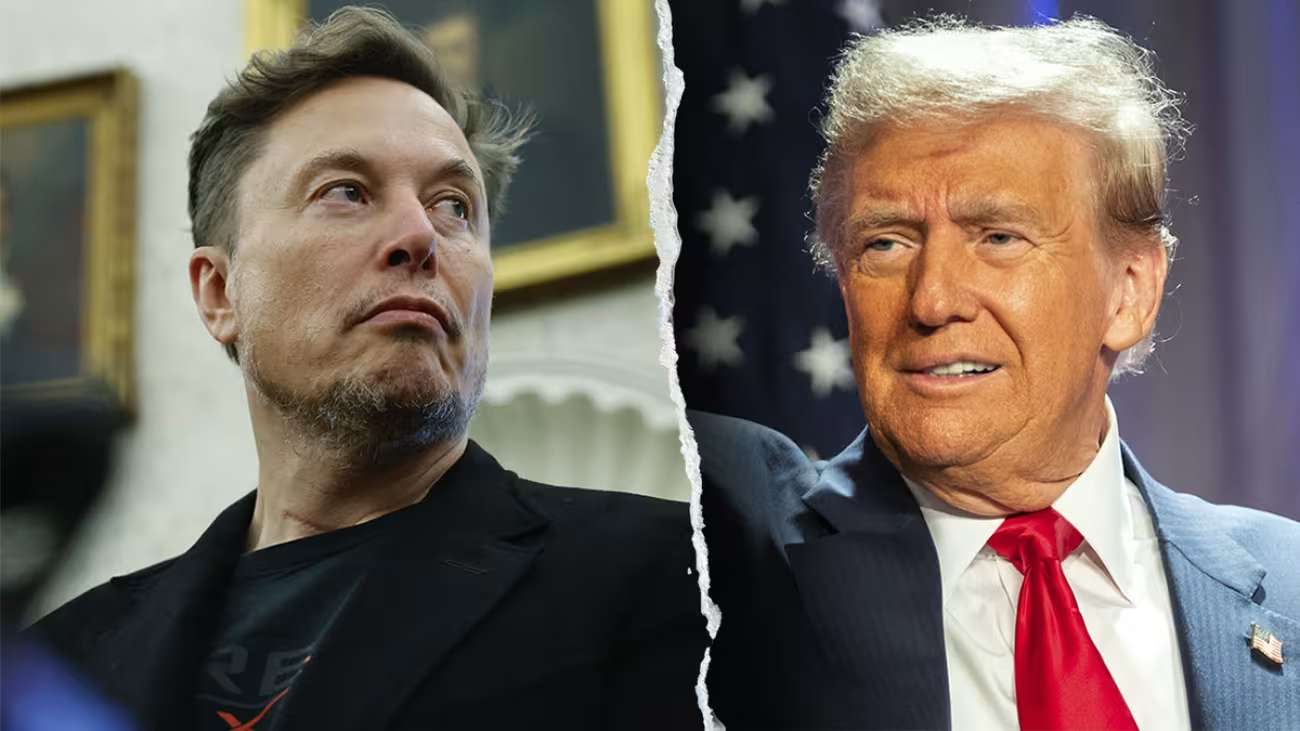
October 12, 2026. Elon Musk has reportedly contributed more than $276 million to Republican political organizations since July 2026, putting the billionaire businessman at the center of a major fundraising effort ahead of the November 3 U.S. midterm elections. The reported contributions include $158 million to the Senate Leadership Fund, more than $76 million to Musk-backed America PAC, and approximately $42 million to four additional Republican groups.
The funding comes at a critical point for Republicans, who hold a 53–47 majority in the U.S. Senate. Several competitive Senate races have attracted substantial outside spending, and political organizations are directing money toward television advertisements, digital campaigns and voter outreach.
The $276 million figure was reported on October 12 using information attributed to Musk's representatives. The complete newly reported amount has not yet been independently reconciled against the next round of Federal Election Commission filings, making it important to distinguish disclosed contributions from verified campaign expenditures.
Nevertheless, existing federal records confirm that Musk's political operation has already become an important financial participant in the midterms. By October 6, America PAC had spent approximately $31 million on federal races, according to WIRED's analysis of Federal Election Commission data.
Where Did Elon Musk's $276 Million Go?
The latest reported contributions were distributed among political organizations with different responsibilities in the Republican campaign effort.
Most of the money went toward Senate-related political activity, particularly through the Senate Leadership Fund and America PAC.
| Recipient | Reported Amount | Purpose |
|---|---|---|
| Senate Leadership Fund | $158 million | Independent spending supporting Republican Senate candidates |
| America PAC | More than $76 million | Political advertising, voter contact and election-related activities |
| Four additional Republican organizations | Approximately $42 million | Other Republican-aligned political efforts |
| Total since July 2026 | More than $276 million | Reported political contributions |
The reported figures describe money contributed to political groups. They do not establish that the full amount has already been spent.
A super PAC can receive a large contribution and retain some of those funds for later advertising, operations or voter mobilization. Public expenditure records identify money actually used for reportable political activity.
That distinction is particularly important when comparing Musk's recent contributions with America PAC's recorded spending.
Why Musk Is Putting So Much Money Into Senate Races
The U.S. Senate is central to the federal government's legislative and appointment processes. Its members vote on legislation, confirm federal judges and senior administration officials, and conduct oversight of executive agencies.
Republicans entered the final weeks of the 2026 midterm campaign with 53 Senate seats. Democrats and independents caucusing with them held 47.
The chamber's balance matters because changes in Senate control would affect committee leadership, the legislative agenda and the confirmation process during President Donald Trump's second term.
Republican-aligned organizations have consequently invested heavily in competitive races, including contests in Texas, Ohio, Michigan, Iowa and other states.
The Senate Leadership Fund, which received the largest reported share of Musk's latest contributions, is specifically organized to support Republican Senate candidates through independent political spending.
What Is the Senate Leadership Fund?
The Senate Leadership Fund is a Republican-aligned super political action committee, commonly called a super PAC.
Its principal objective is to support Republican candidates running for the U.S. Senate. The organization purchases advertisements and undertakes other activities intended to influence federal elections.
Under federal election law, super PACs can accept unlimited contributions from eligible donors but cannot coordinate independent expenditures with candidates or their official campaign committees.
How Much Money Did the Group Already Have?
According to FactCheck.org's review of Federal Election Commission filings, the Senate Leadership Fund had raised $253.7 million for the 2026 election cycle as of June 30.
Its reported cash balance stood at approximately $238.6 million.
Those figures preceded the additional $158 million contribution attributed to Musk in the October 12 reporting.
The earlier balance demonstrates that the organization already controlled substantial financial resources before the newly disclosed contribution.
The Senate Leadership Fund has received support from other major Republican donors, including Miriam Adelson and Paul Singer, as well as funding from an affiliated nonprofit organization called One Nation.
Because these organizations have different reporting requirements, their finances should be examined separately when evaluating political spending.
America PAC: Musk's Political Organization
America PAC became prominent during the 2024 presidential campaign as a major outside organization supporting Donald Trump and other Republican candidates.
Musk provided most of the group's funding, enabling it to undertake advertising and extensive voter-contact operations.
Financial Times reporting based on federal filings found that Musk contributed more than $250 million to political efforts supporting Trump during the 2024 election.
America PAC subsequently became a continuing vehicle for Musk's political spending.
Following a relatively quiet period, the organization increased its federal election activity during the second half of 2026.
America PAC's Spending Through October 6
WIRED's analysis of federal campaign-finance records provides a more detailed picture of how America PAC deployed resources during the current election.
| Spending Measure | Amount |
|---|---|
| Total recorded candidate-related spending | Approximately $31 million |
| Spending across seven Senate contests | Approximately $24.8 million |
| Share of tracked spending directed to those Senate contests | Approximately 80% |
| Texas spending opposing James Talarico | Approximately $9.4 million |
| Texas spending supporting Ken Paxton | Approximately $1.8 million |
These figures reflect spending recorded through October 6, not the total amount America PAC may ultimately spend before Election Day.
The approximately $31 million tracked in the analysis also should not be interpreted as the entirety of the $76 million newly reported contribution from Musk.
Contributions and expenditures represent different financial transactions, and additional filings are needed to reconstruct the complete flow of funds.
Why America PAC Is Spending More on Opposition Ads
One notable feature of America PAC's 2026 spending is its emphasis on advertisements opposing Democratic candidates.
WIRED found that, within the Senate contests it analyzed, the group spent approximately three dollars attacking Democratic candidates for every dollar it spent directly supporting Republicans.
This pattern is not unusual in competitive U.S. elections. Independent political organizations often allocate advertising budgets between messages promoting their preferred candidates and messages criticizing opponents.
However, the available expenditure data does not establish why every individual advertising decision was made or whether a specific advertisement changed voters' preferences.
Assessing advertising effectiveness requires separate evidence about audience exposure, voter responses and electoral behavior.
Texas: America PAC's Spending in the Paxton–Talarico Race
Texas has been a major focus of America PAC's Senate spending.
Republican Attorney General Ken Paxton is facing Democratic state representative James Talarico in the November 3 election.
As of October 6, America PAC had spent approximately $9.4 million opposing Talarico and $1.8 million supporting Paxton.
Combined, those expenditures amounted to approximately $11.2 million in the Texas Senate contest.
The spending illustrates how an outside political organization can direct substantial resources toward one race without transferring the same amount directly to either candidate's campaign.
Texas has not elected a Democrat to statewide office since 1994, but the current contest has attracted extensive national coverage and political spending.
Recent polling has shown varying levels of support for both candidates. Those survey results describe voter preferences at particular times and do not constitute an election outcome.
Ohio and Iowa Also Receive Major Political Spending
America PAC's activities extend beyond Texas.
Ohio Senate Race
In Ohio, Republican Senator Jon Husted faces former Democratic Senator Sherrod Brown.
WIRED's October analysis identified approximately $3.3 million in America PAC expenditures opposing Brown and another $1.6 million supporting Husted.
That represented approximately $4.9 million in recorded spending across those two categories.
The figures show how the organization has used both negative and positive political messaging within the same contest.
Iowa Senate Race
In Iowa, Republican Ashley Hinson faces Democrat Josh Turek.
America PAC's tracked expenditures included approximately $1.5 million opposing Turek and $100,000 supporting Hinson.
The disparity between those amounts reflects the organization's reported allocation at that point in the campaign.
The Iowa contest has also attracted attention because of agricultural concerns, household expenses and disagreements over federal policies.
Other Republican and Democratic political organizations are active in these states, so America PAC's spending represents only part of the total campaign-finance picture.
Musk's Return to Republican Politics After His Dispute With Trump
Musk's latest political contributions follow a period of disagreement with President Trump.
After supporting Trump's 2024 election campaign, Musk became involved in the administration's government-efficiency initiative.
Their relationship later became strained during public disputes over federal spending and policy.
In May 2025, Musk said he intended to reduce his political donations, explaining that he believed he had already spent enough.
He subsequently criticized major legislation backed by Trump and discussed creating a new political party.
By the second half of 2026, however, America PAC had resumed substantial campaign spending, and new reporting described major additional contributions to Republican organizations.
The change is documented through public statements and political-finance activity. Musk's full private reasoning for the contributions is not independently established.
How Musk's 2026 Political Funding Compares With 2024
Musk's political giving became nationally significant during the 2024 presidential election.
Federal filings showed that he contributed more than $250 million to political organizations supporting Trump, including substantial funding for America PAC.
America PAC spent approximately $261 million during the 2024 election cycle, according to FactCheck.org and subsequent financial reporting.
Its 2026 spending has a different immediate focus, emphasizing congressional elections rather than a presidential contest.
The newly reported $276 million in contributions since July 2026 is therefore notable both for its size and its concentration on organizations involved in midterm elections.
However, comparing the figures requires attention to their definitions: the 2024 amount includes reported political giving or committee expenditure, depending on the measure, while the October 2026 figure describes newly reported contributions to multiple organizations.
Can a Billionaire Legally Donate $276 Million to Political Groups?
Under U.S. federal election law, direct contributions to candidates are subject to limits.
Independent-expenditure-only political committees, commonly called super PACs, operate under a different framework.
Following major court decisions including Citizens United v. Federal Election Commission in 2010 and subsequent campaign-finance litigation, super PACs can generally accept unlimited contributions from eligible sources.
They may use those funds for independent political expenditures supporting or opposing candidates.
However, federal law prohibits these expenditures from being coordinated with candidate campaigns.
Super PACs must also disclose financial activity through reports filed with the Federal Election Commission.
Whether any particular transaction complies with election law depends on the donor, recipient, expenditure and applicable reporting rules.
Political Donations vs. Campaign Spending: Why the Difference Matters
Large campaign-finance figures can be misleading when they are presented without explaining what they measure.
| Financial Term | Meaning |
|---|---|
| Contribution | Money or something of value provided to a political committee. |
| Independent expenditure | Political spending expressly supporting or opposing a candidate without prohibited coordination. |
| Cash on hand | Funds held by a committee at the end of a reporting period. |
| Receipts | Money received by a committee during a reporting period. |
| Disbursements | Payments made by a committee, including expenses other than direct candidate-related advertising. |
For example, a $100 million contribution does not mean $100 million in advertisements have already appeared.
A political committee may retain funds, use them for operations, distribute money to other organizations where permitted, or pay for campaign-related activity over time.
This is why the reported $276 million in new contributions and the approximately $31 million of tracked America PAC candidate-related spending are separate figures rather than contradictory totals.
What Do FEC Records Show, and What Remains Unverified?
The Federal Election Commission publishes campaign-finance disclosures for federal candidates and registered political committees.
These records allow the public to examine contributions, expenditures and reported cash balances.
FactCheck.org's September 2026 review found that America PAC had raised more than $50.3 million during the current cycle through June 30, with almost all of those contributions coming from Musk or an affiliated entity.
The committee had reported relatively limited independent expenditures by that date before substantially increasing its activity later in the year.
WIRED subsequently analyzed America PAC's daily reported spending and identified approximately $31 million in candidate-related expenditures through October 6.
The October 12 report of more than $276 million in additional political contributions provides a newer funding picture, but the complete breakdown remains subject to confirmation through subsequent disclosures.
Why October 15 Is an Important Date
The next scheduled federal campaign-finance reporting deadline falls on October 15, 2026.
New reports should provide additional information about committee finances during the relevant reporting period.
They may help clarify how the contributions described in the latest reporting appear in official financial disclosures.
However, not every type of political organization follows identical disclosure schedules, and some transactions may be reported under different rules.
It is therefore important to review the actual filings before treating a newly reported donation total as fully audited.
The Broader Debate Over Wealth and Political Influence
Musk's reported donations also highlight a longstanding disagreement about money in American elections.
Supporters of independent political spending argue that individuals and organizations have a constitutional interest in expressing political views and supporting candidates.
Critics argue that large contributions give wealthy donors substantial influence over which political messages are distributed and which races receive attention.
Both perspectives are part of continuing debates over campaign-finance regulation, transparency and the consequences of concentrated political spending.
Independent political organizations can expand the reach of campaign messages, but their expenditures do not automatically establish influence over a candidate's official decisions.
Likewise, a large donation does not prove that a donor obtained a particular government benefit or policy concession.
Those questions require separate evidence beyond the contribution itself.
What Happens Next in the 2026 Midterm Elections?
Election Day is scheduled for November 3, 2026.
Before then, political committees will continue purchasing advertisements, organizing voter outreach and reporting certain financial activities.
The Senate contests in Texas, Ohio, Michigan, Iowa and several other states will receive significant national attention because control of the chamber affects legislation, executive appointments and congressional oversight.
The next FEC disclosures will also provide an opportunity to examine whether reported contributions match the amounts formally recorded by political committees.
Although campaign spending is an important part of electoral competition, it is only one factor among candidate positions, public concerns, participation and voter decisions.
Frequently Asked Questions
How much did Elon Musk donate to Republicans in 2026?
An October 12 report attributed more than $276 million in contributions since July 2026 to Musk, distributed among Republican-aligned political organizations.
How much did Musk give to the Senate Leadership Fund?
The latest reporting describes an approximately $158 million contribution to the Senate Leadership Fund.
How much did Musk contribute to America PAC?
More than $76 million of the newly reported contributions were directed toward America PAC.
Where has America PAC spent money?
FEC-based research shows major candidate-related expenditures in Senate races including Texas, Ohio, Iowa and Michigan.
Did America PAC already spend all $76 million?
Not according to the available expenditure evidence. WIRED tracked approximately $31 million in candidate-related spending through October 6. That figure does not represent all committee expenses or establish the status of every newly reported contribution.
Can super PACs accept unlimited donations?
Yes. Under current federal rules, independent-expenditure-only political committees may accept unlimited contributions from eligible donors, subject to applicable laws and disclosure requirements.
When will more campaign-finance details become available?
The next major FEC reporting deadline is October 15, 2026, when additional committee disclosures are expected.
Conclusion
Elon Musk's reported $276 million in contributions to Republican political groups represents a major development in the financing of the 2026 midterm elections.
The newly reported funding is concentrated in organizations working on congressional races, particularly the Senate Leadership Fund and America PAC.
Existing federal records show that America PAC has already spent tens of millions of dollars on candidate-related political activity, with a particular emphasis on competitive Senate contests.
The most important distinction is between money contributed and money spent. The latest figures describe a substantial influx of reported financial support, while publicly tracked expenditures provide a separate measure of how those resources are being deployed.
With additional campaign-finance disclosures expected on October 15 and Election Day approaching on November 3, the full scale and allocation of Musk's 2026 political spending will become clearer as further records are published.
- Log in to post comments