Andrew Brown Jr., a 42-year-old Black father of seven, was fatally shot by Pasquotank County sheriff's deputies outside his home in Elizabeth City, North Carolina, on April 21, 2021. The incident sparked nationwide protests and renewed discussions about police accountability, racial justice, and the use of deadly force.
Although authorities determined that the deputies were legally justified in using deadly force, Brown's family disputed that conclusion, pointing to autopsy findings and available body-camera footage. The family eventually reached a $3 million civil settlement with Pasquotank County in 2022.
Five years later, the shooting continues to affect Elizabeth City, where residents and civil rights advocates are still calling for greater transparency and accountability.
Who Was Andrew Brown Jr.?
Andrew Brown Jr. was a 42-year-old resident of Elizabeth City, a small community in northeastern North Carolina. He was a father of seven children and lived on Perry Street with his family.
Brown's death became a significant national news story because of the circumstances surrounding the shooting and the subsequent disagreement between authorities and his family over whether the use of deadly force was justified.
Before his death, Brown had been the subject of a drug-related investigation. Deputies were attempting to execute arrest and search warrants at his residence when the fatal confrontation occurred.
His family and friends remembered him as a father whose death left a lasting impact on his children and the wider community.
What Happened During the Andrew Brown Jr. Shooting?
On the morning of April 21, 2021, deputies from the Pasquotank County Sheriff's Office and assisting law enforcement agencies arrived at Brown's residence on Perry Street in Elizabeth City.
They were there to serve drug-related arrest and search warrants as part of an investigation into alleged illegal drug activity.
Brown was sitting inside his BMW in the driveway when the deputies approached. According to the investigation, he attempted to drive away as officers surrounded his vehicle.
The confrontation escalated quickly. Three deputies opened fire, shooting a total of 14 rounds at Brown's vehicle, according to the district attorney's account.
Brown was struck by gunfire and his vehicle eventually crashed into a tree. Deputies then approached the vehicle and attempted to provide emergency medical assistance.
He was pronounced dead shortly afterward.
The incident occurred within approximately one minute, making the brief encounter a central issue in subsequent investigations and public debate.
Was the Elizabeth City Police Department Involved?
An important detail frequently misunderstood in coverage of the incident is that the Elizabeth City Police Department did not conduct the shooting.
The officers who fired their weapons were Pasquotank County sheriff's deputies. Deputies from other law enforcement agencies were also involved in the operation.
The Elizabeth City Police Department responded after receiving a report of shots fired and assisted with securing the area.
This distinction was explicitly clarified during an emergency Elizabeth City City Council meeting on April 21, 2021.
Andrew Brown Jr. Autopsy: What Did the Medical Examiner Find?
The autopsy findings became one of the most important elements of the controversy because they confirmed that Brown had been shot in the back of the head.
Two different examinations were conducted: an independent autopsy commissioned by Brown's family and the official examination performed by North Carolina's medical examiner.
Independent Autopsy Findings
The family's independent pathologist reported that Brown had sustained five gunshot wounds. Four involved his right arm, while the fatal wound struck the back of his head.
The family's attorneys argued that these findings supported their position that Brown was attempting to escape when deputies opened fire.
Official State Autopsy Findings
The North Carolina medical examiner's report, released in June 2021, identified the cause of death as a gunshot wound to the back of the head.
The official report documented two gunshot wounds: one to the head and another to the arm. It classified the death as a homicide.
The difference between the independent and official reports concerned the number of documented wounds. Both identified the gunshot wound to the back of the head as fatal.
Importantly, the medical classification of homicide means that death resulted from another person's actions. It does not, by itself, determine whether the shooting constituted a criminal offense under the law.
Why Did the District Attorney Decide Not to Charge the Deputies?
On May 18, 2021, Pasquotank County District Attorney Andrew Womble announced that the three deputies who fired their weapons would not face criminal charges.
Following a review of the North Carolina State Bureau of Investigation's findings, Womble concluded that the deputies were justified in using deadly force.
His explanation was that Brown had driven his vehicle toward officers, allegedly striking one deputy and creating a threat to their safety.
Womble argued that the deputies reasonably believed deadly force was necessary to protect themselves and others.
However, Brown's family strongly rejected this interpretation.
Their attorneys argued that Brown was attempting to escape rather than attack officers. They also questioned why deputies continued firing as his vehicle moved away from the initial confrontation.
The decision not to bring criminal charges became a major source of anger among residents and civil rights advocates.
Body-Camera Footage and the Controversy Over Transparency
Another major issue involved the release of body-camera footage from the shooting.
Initially, Brown's family was shown only a short, approximately 20-second segment of the footage. The family and its attorneys described what they saw as evidence of an unjustified shooting.
Additional footage was subsequently shown privately to family representatives.
On May 18, District Attorney Womble presented portions of the recordings during a public news conference to explain his decision not to prosecute the deputies.
However, North Carolina law placed restrictions on the public release of law enforcement body-camera recordings. Only partial and redacted footage was ultimately authorized for public release.
The limited availability of the recordings contributed to continuing concerns about transparency and independent oversight.
Protests Erupted Across Elizabeth City
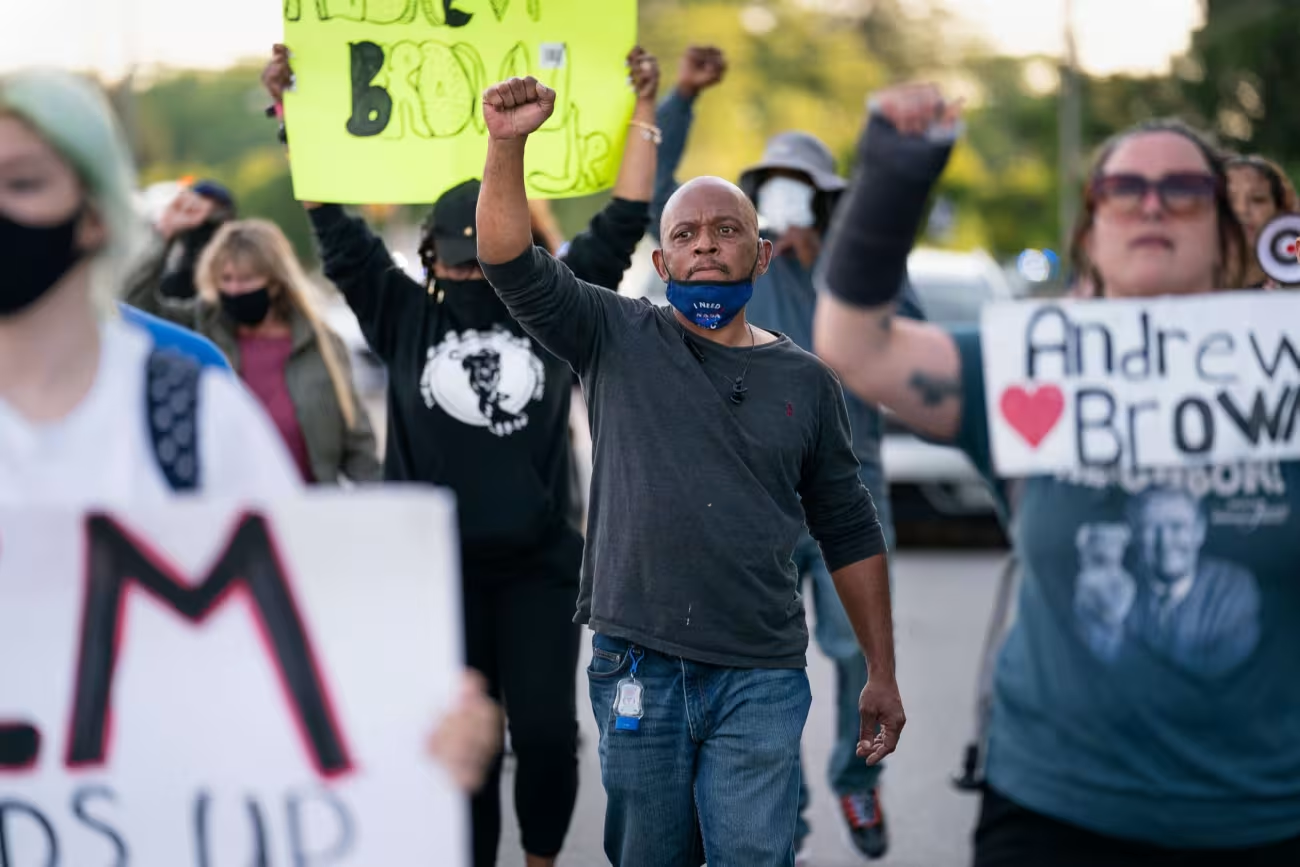
Brown's death triggered demonstrations in Elizabeth City and attracted national attention amid broader protests against police violence in the United States.
Residents, civil rights organizations, and activists demanded accountability and greater transparency from the Pasquotank County Sheriff's Office.
Demonstrations included marches, public gatherings, and calls for the release of body-camera footage.
The local government also held emergency meetings to discuss the shooting and its impact on the community.
For many residents, the incident became more than an individual police shooting. It raised broader questions about how law enforcement interacts with Black communities and how allegations of excessive force are investigated.
Andrew Brown Jr. Family Receives $3 Million Settlement
In June 2022, Pasquotank County reached a $3 million settlement with Brown's family to resolve their civil lawsuit.
The family had originally filed a $30 million civil rights lawsuit against the county and individuals associated with the shooting.
The settlement was funded through the county's liability insurance arrangements, which included a reported $2 million insurance policy limit.
The agreement represented a significant financial resolution for the family after the criminal investigation ended without charges against the deputies.
However, a civil settlement should not be interpreted as a criminal conviction or an admission of liability unless the agreement explicitly establishes one.
What Happened to the Deputies Involved?
Three Pasquotank County deputies fired their weapons during the encounter:
- Daniel Meads
- Robert Morgan
- Aaron Lewellyn
Following the shooting, the deputies were placed on administrative leave while the incident was investigated.
Sheriff Tommy Wooten subsequently announced that the involved officers would retain their positions, although disciplinary measures and additional training were discussed.
One of the deputies who fired during the incident later resigned.
The decision not to terminate the officers generated further criticism from Brown's family and members of the local community.
Andrew Brown Jr.'s Legacy Five Years After His Death
On April 21, 2026, Elizabeth City marked the fifth anniversary of Brown's death.
In an April 23 report, WUNC News documented how the shooting continued to affect residents, particularly those who knew Brown and those who had participated in demonstrations demanding accountability.
A mural painted in his memory remains an important visual reminder of the incident and its impact on the community.
Local residents interviewed by WUNC described continuing mistrust toward law enforcement and a feeling that important questions about the shooting had never been fully resolved.
Since 2021, several local initiatives have attempted to improve relations between law enforcement and residents.
These include the creation of the Pasquotank County Citizens' Advisory Council in 2022, a 13-member body established to receive complaints and provide a channel for community oversight of the Sheriff's Office.
The county also developed the Pasquotank Peace Initiative, which recommended improved de-escalation training and stronger engagement between officers and residents.
Despite these efforts, community advocates continue to call for more meaningful accountability and transparency.
Latest Update on the Andrew Brown Jr. Case
As of November 2026, the major established developments are:
- April 21, 2021: Andrew Brown Jr. was fatally shot by Pasquotank County sheriff's deputies in Elizabeth City.
- May 18, 2021: District Attorney Andrew Womble announced that the deputies would not face criminal charges.
- June 2021: The official autopsy confirmed a fatal gunshot wound to the back of Brown's head.
- June 2022: Brown's family reached a $3 million civil settlement with Pasquotank County.
- 2022: The Citizens' Advisory Council was established to provide an additional channel for community oversight.
- April 23, 2026: WUNC reported on the fifth anniversary and continuing calls for healing and accountability in Elizabeth City.
The criminal decision not to charge the deputies and the subsequent civil settlement remain separate legal outcomes. The settlement did not reverse the district attorney's decision or establish criminal guilt.
Final Thoughts
Andrew Brown Jr.'s death remains one of the most significant police-shooting controversies in North Carolina in recent years.
The 2021 shooting, the conflicting interpretations of the available evidence, and the decision not to prosecute the deputies created lasting divisions between law enforcement and sections of the Elizabeth City community.
Although the family received a $3 million settlement in 2022, the fifth anniversary demonstrated that the demand for transparency and accountability has not disappeared.
For Brown's family, his death represents the loss of a father and loved one. For Elizabeth City, his name remains connected to an ongoing conversation about policing, public trust, and the need for meaningful institutional accountability.
- Log in to post comments