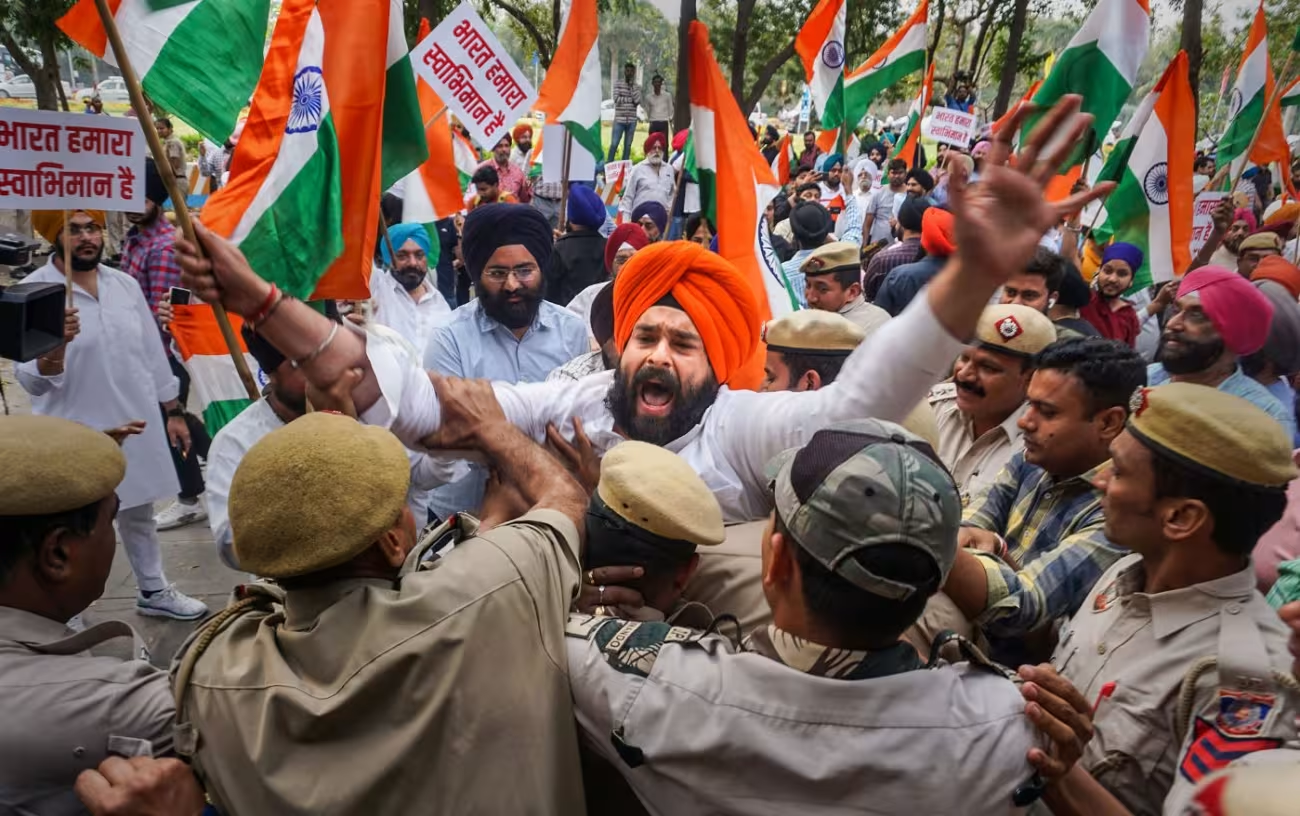
NEW DELHI, October 11, 2026 — A Sikh house of worship became an unexpected refuge for hundreds of protesters as Indian police mounted an extensive security operation across New Delhi on Saturday, October 10. Demonstrators associated with the Cockroach Janta Party (CJP) gathered at Gurdwara Bangla Sahib before attempting to reach Jantar Mantar, where authorities had prohibited a major rally demanding the resignation of Chief Election Commissioner Gyanesh Kumar.
The confrontation spread beyond the planned demonstration site. Police detained thousands of people, restricted access to central Delhi, closed metro stations and disrupted mobile internet services. Groups of protesters nevertheless assembled at roads, markets and other public spaces, turning a planned mass rally into a series of smaller demonstrations.
Reuters reported that more than 2,000 people had been detained, citing a Home Ministry official. A subsequent report from The Indian Express, updated early on October 11, estimated approximately 6,000 detentions across Delhi. The CJP separately claimed that more than 15,000 people had faced detention or police action. Those figures come from different sources and should not be treated as independently verified totals.
The unrest follows mounting criticism of India's Special Intensive Revision (SIR) of electoral rolls, a process that removed roughly 130 million voter-list entries. Opposition parties and activists allege that the revisions were politically motivated, while the Election Commission of India and the ruling Bharatiya Janata Party (BJP) deny wrongdoing.
Inside Gurdwara Bangla Sahib: How Protesters Found Shelter
Gurdwara Bangla Sahib, one of Delhi's best-known Sikh religious sites, became an important gathering point as security forces blocked access to Jantar Mantar. The gurdwara is situated in central New Delhi, approximately one kilometre from the Election Commission's office on Ashoka Road.
Hundreds of demonstrators arrived from Delhi and other Indian states, with some spending the night at the religious complex before the planned rally.
According to The Indian Express, protesters rested, ate and waited inside the gurdwara while police monitored the surrounding area. A member of the gurdwara's management said officers had asked the institution to send the demonstrators outside, but the management refused.
The staff member explained that visitors entering the gurdwara were not automatically treated as political participants and that the students should not be expelled merely because they intended to protest.
One visitor, Kamaljeet Singh, who had travelled from Madhya Pradesh, estimated that between 1,000 and 2,000 student protesters had arrived since the previous night. This was an eyewitness estimate, not an independently established attendance count.
Singh said officers approached the premises around 8 a.m. and that some entered an area near the main gate before management representatives intervened. Accounts from people present indicated that the institution resisted attempts to remove students from inside.
Outside the main entrance, police detained groups of demonstrators as they emerged. The Indian Express directly reported more than 100 detentions outside the gurdwara, while Singh estimated that approximately 150 to 200 students were taken into custody nearby.
One protester, Anuradha Mewara, who had travelled from Rajasthan, said she was detained outside the complex and later released near the Red Fort after being transported in a police bus.
The events highlighted the contrast between the relative safety protesters described inside the religious premises and the police operation taking place immediately beyond its gates.
Why Police Prevented the Jantar Mantar Rally
The CJP had planned to begin its demonstration at Jantar Mantar at approximately 10:30 a.m. on October 10. Organizers intended to demand Gyanesh Kumar's resignation and challenge the handling of electoral-roll revisions.
Delhi Police refused permission, explaining that the application was submitted on October 7 rather than within the prescribed advance-notice period. Authorities also cited security concerns and earlier instances in which demonstrators had allegedly failed to comply with lawful directions.
On October 9, India's Ministry of Home Affairs warned state and territorial administrations about potential public-order problems associated with the planned mobilization.
Security arrangements included barricades, vehicle inspections, checkpoints, personnel at major intersections and restrictions on access to designated areas.
More than 37 security checkpoints had been planned across the New Delhi district. Authorities paid particular attention to locations including Tolstoy Road, Ashoka Road and the Shangri-La roundabout, which had been associated with earlier protest activity.
By Saturday morning, Jantar Mantar was effectively inaccessible to large groups of protesters. Police and paramilitary personnel guarded surrounding roads, while drones and anti-riot vehicles were deployed to monitor movement.
Some metro stations and markets were closed, and mobile internet services were suspended in parts of the central business district. The measures disrupted movement for demonstrators and other residents alike.
Protest Leaders Detained After Arriving From Mumbai
Police also acted against the CJP's leadership before its organizers could reach the demonstration.
At approximately 10:20 a.m., officers entered an aircraft that had arrived in Delhi from Mumbai and detained three prominent movement figures: founder Abhijeet Dipke, spokesperson Saurav Das and senior organizer Ashutosh Ranka.
Television footage showed Dipke confronting officers inside the aircraft. The movement subsequently condemned the detentions and demanded the leaders' release.
Following the operation, the three were taken to separate locations, according to local reporting. In a recorded message released later, Dipke designated Ajinkya Shinde, the CJP's national organization in-charge, to lead the movement.
Another development emerged when Dipke learned that his paternal grandmother had died. Delhi Police said he was informed of the death and offered assistance to return to Maharashtra for the funeral.
Despite the detention of its principal organizers, the CJP continued coordinating demonstrations through supporters and allied student organizations.
Flash Protests Spread Across Delhi Despite Barricades
With the central rally prevented, protesters gathered in smaller groups at multiple locations. By the afternoon, demonstrations involving approximately 100 to 150 participants at a time were reported in different parts of the city.
Dilli Haat and Safdarjung Flyover
Protesters assembled near Dilli Haat, a popular market, where police detained student activists and other participants. Neha Bora, a leader of the All India Students' Association (AISA), was detained in the area alongside activists Yogendra Yadav and Prashant Bhushan.
Bora subsequently reported that she had been released by approximately 7 p.m.
Additional demonstrators gathered around the Safdarjung Airport flyover, where police moved to prevent groups from joining larger assemblies.
Connaught Place, Rajghat and Central Delhi
Other gatherings occurred around Connaught Place, Rajghat and nearby streets. Police detained protesters near Regal Cinema, Minto Bridge and Akashwani Bhawan.
Near Shivaji Stadium Metro Station, demonstrators raised slogans while police attempted to disperse small groups. Some participants wore helmets modified with antennae resembling cockroaches, reflecting the CJP's unusual political identity.
The scattered protests complicated an operation originally designed to prevent a single large gathering at Jantar Mantar.
The day did not produce the scale of violence associated with some earlier demonstrations, but isolated confrontations occurred. The Indian Express reported that stones were thrown at a bus carrying detainees near Jhandewalan. Police said six personnel sustained injuries during protest-related operations.
How Many Protesters Were Detained?
Detention figures changed throughout October 10 as reports emerged from different locations.
Reuters reported more than 2,000 detentions in Delhi, based on information from a Home Ministry official. The Indian Express subsequently estimated that approximately 6,000 people had been detained across the capital, including political leaders, students, activists, journalists and people who said they were bystanders.
The CJP claimed in a statement that more than 15,000 people had faced detention or police action. This substantially higher figure has not been independently confirmed.
Police sources separately reported around 1,200 preventive detentions overnight and approximately 500 people detained while arriving in groups during the morning. These figures represent particular phases of the operation and should not simply be added to later citywide estimates.
Detentions were also reported outside Delhi. Reuters said local media had reported approximately 400 people held in Mumbai.
Journalists were among those affected. Representatives of two digital news organizations said four of their reporters had been briefly detained, while a Reuters journalist was also temporarily held before being released.
Because some detainees were released during the day, and because reports described different categories of police action, the available figures do not establish how many people remained in custody at any particular moment.
Senior Opposition Leaders Among Those Detained
The police operation also involved prominent figures from several opposition parties.
Former West Bengal Chief Minister Mamata Banerjee was detained outside her Delhi residence alongside members of the Trinamool Congress.
Former Delhi Chief Minister Arvind Kejriwal was detained near his Lodhi Estate residence along with senior Aam Aadmi Party figures, including Sanjay Singh and Saurabh Bharadwaj.
Former Kerala Chief Minister Pinarayi Vijayan was taken to Chhatrasal Stadium, while former Tripura Chief Minister Manik Sarkar was also reported among those detained.
Opposition leader Rahul Gandhi criticized the restrictions and said demonstrations would continue despite the police response.
Delhi Chief Minister Rekha Gupta defended the authorities' determination to maintain order. BJP leaders accused opposition parties of encouraging instability and using the dispute over electoral rolls to undermine the government's democratic mandate.
The opposing reactions reflected a wider political divide over whether the restrictions were proportionate public-safety measures or an excessive response to organized dissent.
What Is the Voter-List Controversy Behind the Protest?
The dispute centers on the Special Intensive Revision, an Election Commission process intended to verify and update electoral registers.
India's voter lists require periodic corrections to account for deaths, changes of residence, duplicate registrations and other circumstances affecting eligibility.
According to Election Commission data cited by Reuters, approximately 130 million voter-list entries were removed during the verification exercise. The reported categories included about 63 million people recorded as having relocated, 30 million who could not be traced and 28 million who had died.
These categories account for most, but not all, of the reported total. More importantly, removing a voter-list entry does not automatically establish that an eligible citizen has been unlawfully deprived of voting rights.
The Election Commission says the removals relate to entries identified during the draft revision process and that eligible voters who were incorrectly deleted can apply to be registered again.
Opposition parties argue that the scale and implementation of the revisions require closer scrutiny, particularly because they believe some eligible voters may have been excluded.
The controversy intensified after The Indian Express reported that two election commissioners had raised concerns about aspects of Gyanesh Kumar's handling of the revisions.
The BJP rejects allegations that the process was designed to influence election results. It maintains that its electoral success reflects voter support rather than manipulation of registration records.
The central unresolved issue is whether the verification process adequately protected eligible voters from incorrect removal and provided accessible ways to challenge errors.
United Nations Raises Concerns Over Mass Detentions
The international response added another dimension to the confrontation.
The United Nations human rights office expressed concern about the scale of detentions before and during the October 10 protests.
UN Human Rights spokesperson Thameen Al-Kheetan called on Indian authorities to respect the right to peaceful assembly and engage in meaningful dialogue over the concerns raised by protesters.
India's mission to the United Nations in Geneva rejected the criticism, describing it as interference in the country's internal affairs.
The Indian mission maintained that the Constitution guarantees peaceful assembly while allowing reasonable restrictions to protect public order.
The exchange illustrated the competing assessments of the same police operation: international human rights concerns about restrictions on protest and the Indian government's position that security measures were justified.
Who Is the Cockroach Janta Party?
The Cockroach Janta Party is a youth-led political protest movement associated with Abhijeet Dipke. Its name and visual symbolism use satire to challenge political authority.
Supporters have adopted cockroach-themed imagery, including helmets fitted with antennae, making the movement visually distinctive during public demonstrations.
The group's campaign against the chief election commissioner has attracted participation from student organizations, civil society activists and political opposition figures.
Its October 10 demonstration followed earlier mobilizations in Delhi and Mumbai, including a protest at Mumbai's Shivaji Park on October 3.
While the CJP has gained public attention through its unconventional methods, its immediate campaign remains centered on electoral accountability and the demand for Gyanesh Kumar's resignation.
Latest Update: CJP Announces Another Rally for October 11
Following Saturday's police operation, the CJP announced plans to resume protests on Sunday, October 11, 2026.
Ajinkya Shinde, now leading the movement's public coordination, called on supporters to march towards Jantar Mantar at 10 a.m.
He urged protesters to assemble wherever police prevented them from proceeding, effectively proposing another series of dispersed demonstrations if access to the designated site remained restricted.
Delhi Police indicated that its security deployment would remain in place, with further transport restrictions possible depending on conditions.
As of the latest verified reports, the October 11 gathering had been announced, but its outcome had not yet been established.
What the Delhi Protests Mean for India's Electoral Debate
The October 10 demonstrations exposed two unresolved issues in Indian public life: confidence in the administration of elections and the limits authorities may impose on political gatherings.
The Election Commission argues that accurate voter registration is necessary to protect electoral integrity. Critics contend that verification procedures must also safeguard eligible voters against wrongful exclusion.
Both objectives are essential to a credible electoral system. Determining whether the revision process met those standards requires transparent records, effective correction procedures and an assessment of disputed removals rather than relying solely on the overall number of deleted entries.
The police response has created a separate debate about freedom of assembly. Authorities cite the need to maintain security, while protesters and opposition leaders argue that widespread detentions and restrictions interfere with legitimate political participation.
For those who gathered at Gurdwara Bangla Sahib, the dispute became immediate and personal. A religious complex offered temporary shelter, but police were waiting outside as demonstrators attempted to continue their journey.
The planned protest at Jantar Mantar was prevented, yet the movement's supporters continued to appear across Delhi. With a further demonstration announced for October 11, the confrontation between the authorities and the CJP remained unresolved.
- Log in to post comments