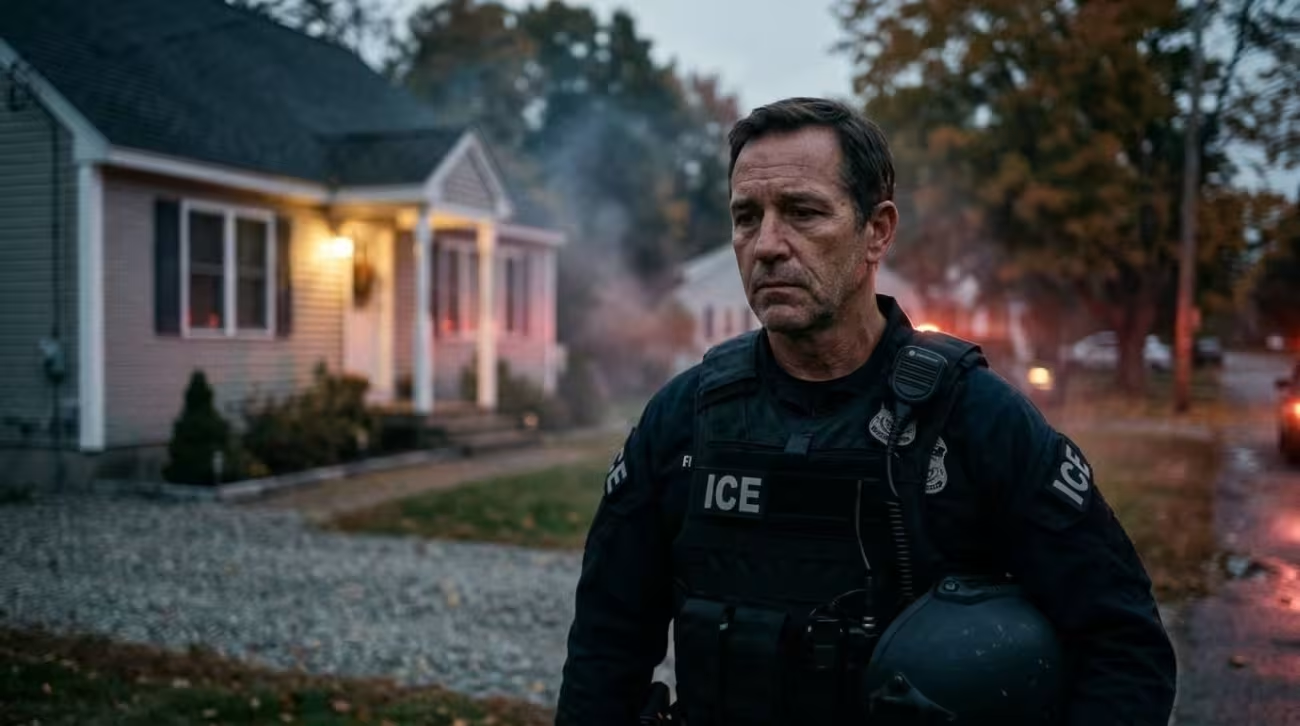
David Brouillette, a 38-year-old Immigration and Customs Enforcement (ICE) officer identified by relatives as the agent who fatally shot Colombian immigrant Johan Sebastián Durán Guerrero in Biddeford, Maine, on July 13, 2026, is at the center of growing scrutiny over federal immigration enforcement. A November 11 investigation by The New York Times uncovered emails in which Brouillette expressed hostility toward a Colombian man who was legally living in the United States and dating his sister. The investigation also examined allegations of domestic abuse, employment problems, questionable statements in court records, and shortcomings in the background-check process that allowed him to begin working at ICE before officials had reviewed his full security report. The revelations have intensified questions about the agency's recruitment standards, the officer's suitability to carry a firearm, and the circumstances surrounding Durán Guerrero's death. The Department of Homeland Security has not officially confirmed Brouillette's identity as the shooter.
Who Is David Brouillette?
David Brouillette is a former U.S. Army sergeant who joined ICE during the Trump administration's major expansion of immigration enforcement personnel.
Before entering federal immigration enforcement, he worked in several military, corrections, security, and public-service positions in Maine. His employment history included work with the Maine Department of Corrections, security at a Veterans Affairs medical facility, and an enforcement position with the state's Department of Health and Human Services.
He also volunteered with a local fire department and applied for law enforcement positions in Maine. However, Hallowell Police Chief Zachary Kindelan told The New York Times that Brouillette had applied to the department but had never been hired as a police officer.
His previous military experience reportedly included service in Afghanistan, where he worked in military intelligence and interrogation-related roles.
Brouillette's background became a national issue after the July 2026 fatal shooting in Biddeford. His former wife and daughter told reporters that he had identified himself as the officer who fired the fatal shots. Other family members also identified him from images showing the aftermath of the incident.
David Brouillette's Anti-Immigrant Emails Revealed
The most significant revelation in the November 11 New York Times investigation involved a series of emails Brouillette exchanged with his sister, Elizabeth Emen, in January 2021.
The disagreement concerned Emen's relationship with a Colombian man who had been living legally in the United States. At the time, the man was a 37-year-old graduate student pursuing a doctorate in education and had been in a relationship with Emen for approximately five years. They also had two children together.
Brouillette objected to the relationship and questioned whether his sister's partner deserved to live in the United States because he was not an American citizen.
In one email, he wrote that the man could take his "non citizen ass back to his country and enjoy his third world luxuries."
He also questioned the man's understanding of American freedom and attacked his family background, claiming that his ancestry did not reflect the values required to appreciate the opportunities offered by the United States.
The comments were particularly significant because Emen said her partner was legally residing in the country. She argued that her brother's hostility was not based on any evidence of illegal immigration but on the man's Colombian background and national origin.
Emen shared the emails with The New York Times and ABC News. A friend who had discussed the exchange with her at the time and a family representative also corroborated the account.
The dispute destroyed the relationship between Brouillette and his sister. Emen later described the emails as an overt expression of anti-immigrant and xenophobic attitudes.
Why the Emails Matter in the Maine Shooting Investigation
The emails have attracted particular attention because the man targeted by Brouillette's remarks was Colombian, the same nationality as Johan Sebastián Durán Guerrero, who was fatally shot during an ICE operation in Maine several years later.
Durán Guerrero was 25 years old and had been living in the United States with his family. His attorney said he was authorized to work in the country and was not the intended target of the immigration operation.
The emails provide evidence of Brouillette's previously expressed hostility toward a Colombian immigrant. However, they do not independently establish that national-origin bias motivated the shooting.
That distinction is important to the ongoing investigations. Prosecutors and investigators must examine the circumstances of the shooting, the officer's actions, the available evidence, and whether any violation of federal or state law occurred.
Former federal prosecutor Michael Gennaco told The New York Times that evidence of racial bias could be relevant to evaluating whether an officer used excessive force, even though prosecutors would not necessarily have to prove racial animus to establish every possible federal civil rights violation.
What Happened to Johan Sebastián Durán Guerrero?
On July 13, 2026, ICE officers were conducting a surveillance operation in Biddeford, Maine, connected to an individual with a final immigration removal order.
During the operation, officers attempted to stop a vehicle driven by Johan Sebastián Durán Guerrero.
The Department of Homeland Security said the vehicle attempted to flee and that an officer fired because he feared for public safety.
However, the government's account has been questioned by the victim's family and local officials. Senator Angus King and other Maine lawmakers said Durán Guerrero was not the intended target of the operation.
Durán Guerrero's family attorney, Sean P. Murphy, said the 25-year-old was shot four times in the face and neck.
He was the father of a young daughter. His death left his wife, Karolina Rojas Alvarez, and other relatives seeking answers about the circumstances surrounding the shooting.
DHS initially characterized Durán Guerrero as having entered the United States illegally but later corrected that statement following inquiries from Senator Angus King's office. His family maintained that he had work authorization and was not the person ICE was attempting to apprehend.
The agency has not publicly identified Brouillette as the officer who fired the weapon. His relatives and former wife have identified him, while the state and federal investigations continue.
Allegations of Domestic Abuse and Troubled Personal Relationships
The New York Times investigation also examined Brouillette's history of difficult personal relationships and allegations made by his former wives.
His two former wives had described incidents of physical abuse and threatening behavior in family court filings and interviews with the media. Brouillette disputed the allegations.
His first former wife, Ashley Brouillette, previously told The Washington Post that he had engaged in violent behavior during their relationship, including an incident in which he allegedly threw boiling water on her while she was holding their young daughter.
She also provided a voicemail containing threatening language that she attributed to him.
His second former wife, Lucinda Brouillette, separately described allegations of physical and emotional abuse in court documents and expressed concerns about their daughter's safety.
These accounts are allegations, not criminal convictions. They are nevertheless relevant to the questions being raised about what information was available to ICE during its recruitment process and whether the agency adequately examined his history before authorizing him to carry a firearm.
Questions About Brouillette's Employment and Court Records
Beyond the allegations made by his former wives, the investigation uncovered discrepancies between some of Brouillette's employment claims and independently verified records.
In a 2019 family court filing, Brouillette represented that he had worked as a police officer for the Hallowell Police Department in Maine.
However, Hallowell Police Chief Zachary Kindelan told The New York Times that Brouillette had applied for a position but was never hired.
Several former federal prosecutors said that inaccurate statements about law enforcement employment could create credibility problems if an officer later needed to testify in court.
In another dispute involving child support, a Maine judge rejected Brouillette's claims about his employment circumstances and found him voluntarily underemployed.
His employment history also included several relatively short periods in different positions between 2015 and 2025.
These findings raised questions about whether ICE had sufficiently investigated his professional history before allowing him to work in federal law enforcement.
How ICE Hired David Brouillette Before Completing His Background Review
One of the most serious findings in the New York Times investigation concerned the timing of Brouillette's recruitment and background checks.
According to a person familiar with his hiring, Brouillette was cleared to begin working at ICE on December 1, 2025, after passing a preliminary screening process that had become more lenient during the agency's recruitment expansion.
The Trump administration had directed ICE to significantly increase its deportation workforce, creating pressure to recruit and deploy thousands of additional officers.
Former and current officials told the Times that some hiring requirements were changed, relaxed, or bypassed to accelerate recruitment.
An agency whistleblower reportedly informed the Department of Homeland Security's Office of Inspector General that the recruitment process involved an unprecedented lowering of standards, allowing some candidates to receive job offers before completing basic identity, fingerprint, and credit checks.
Brouillette's full background investigation was subsequently conducted by an outside contractor. However, ICE officials had not yet reviewed the completed report for potential disqualifying information when the Maine shooting occurred on July 13, 2026.
Although he had not received full clearance, Brouillette was already working in the field, carrying a firearm and participating in immigration enforcement operations.
This distinction is central to the controversy: the investigation did not establish that ICE had formally approved every aspect of his background. Rather, it found that he had been deployed before officials had examined the completed background report for potential red flags.
Why Was Brouillette Allowed to Skip Full ICE Training?
The investigation also raised questions about the training Brouillette received before beginning field assignments.
According to two people familiar with his employment history, he was permitted to bypass ICE's full training course in Georgia.
Instead, he completed a shorter online training program under a practice used for recruits with previous law enforcement experience.
His military and public-service background reportedly helped him qualify for the accelerated arrangement.
However, the decision has attracted scrutiny because ICE officers have authority to conduct arrests, carry firearms, and use force when legally justified.
Representative Chellie Pingree argued that ICE should not have deployed Brouillette as an armed officer before completing a thorough examination of his background.
She called for greater transparency concerning his recruitment, screening, training, and authorization to carry a weapon.
ICE and DHS Respond to the Allegations
The Department of Homeland Security has defended its recruitment and training practices and rejected claims that ICE officers were being hired without adequate screening.
A DHS spokesperson said incoming officers were onboarded in accordance with applicable policies and standards and described claims of inadequate vetting or training as false.
The department also declined to confirm or deny whether Brouillette was the officer who fired the fatal shots in Biddeford.
DHS said it would not publicly confirm the identities of federal law enforcement officers in response to efforts to identify them.
The agency's position differs from the accounts provided by Brouillette's former wife, daughter, and other relatives, who have identified him as the shooter.
The conflicting accounts make the ongoing state and federal investigations particularly important.
Who Is Investigating Johan Durán Guerrero's Death?
The Maine Attorney General's Office is conducting the state investigation into the fatal shooting.
Attorney General Aaron Frey confirmed that his office has exclusive responsibility under Maine law for investigating homicides involving law enforcement officers acting in an official capacity.
The investigation includes collecting and analyzing evidence and determining whether the available information supports criminal action under state law.
The Department of Homeland Security's Office of Inspector General is conducting a separate federal investigation into the use of deadly force.
Investigators have also interviewed people familiar with Brouillette's personal and professional history, including his former wife.
According to the New York Times, local and federal investigators have sought information about his background and whether his history should have affected his suitability for federal law enforcement employment.
After completing its investigation, the Maine Attorney General's Office is expected to submit the case file to the state's Deadly Force Review Panel for review and recommendations.
As of November 12, 2026, Brouillette had not been publicly charged with a crime in connection with Durán Guerrero's death.
Conclusion
David Brouillette's background has become a central issue in the investigation of Johan Sebastián Durán Guerrero's fatal shooting in Biddeford, Maine.
The November 2026 New York Times investigation revealed anti-immigrant emails directed at a Colombian man who was legally living in the United States, alongside allegations of domestic abuse, employment discrepancies, and questions about his professional suitability.
More importantly, the investigation raised serious concerns about ICE's recruitment procedures. Brouillette was allowed to begin working as an armed immigration officer before agency officials had reviewed his full background investigation, and he reportedly received an abbreviated training program.
Although these findings do not independently prove that prejudice motivated the shooting, they have intensified questions about the agency's responsibility for screening and supervising officers entrusted with federal law enforcement powers.
The Maine Attorney General's investigation and the federal inspector general's review will be essential in determining whether the shooting was lawful and whether failures in ICE's recruitment and oversight contributed to the circumstances surrounding Durán Guerrero's death.
- Log in to post comments