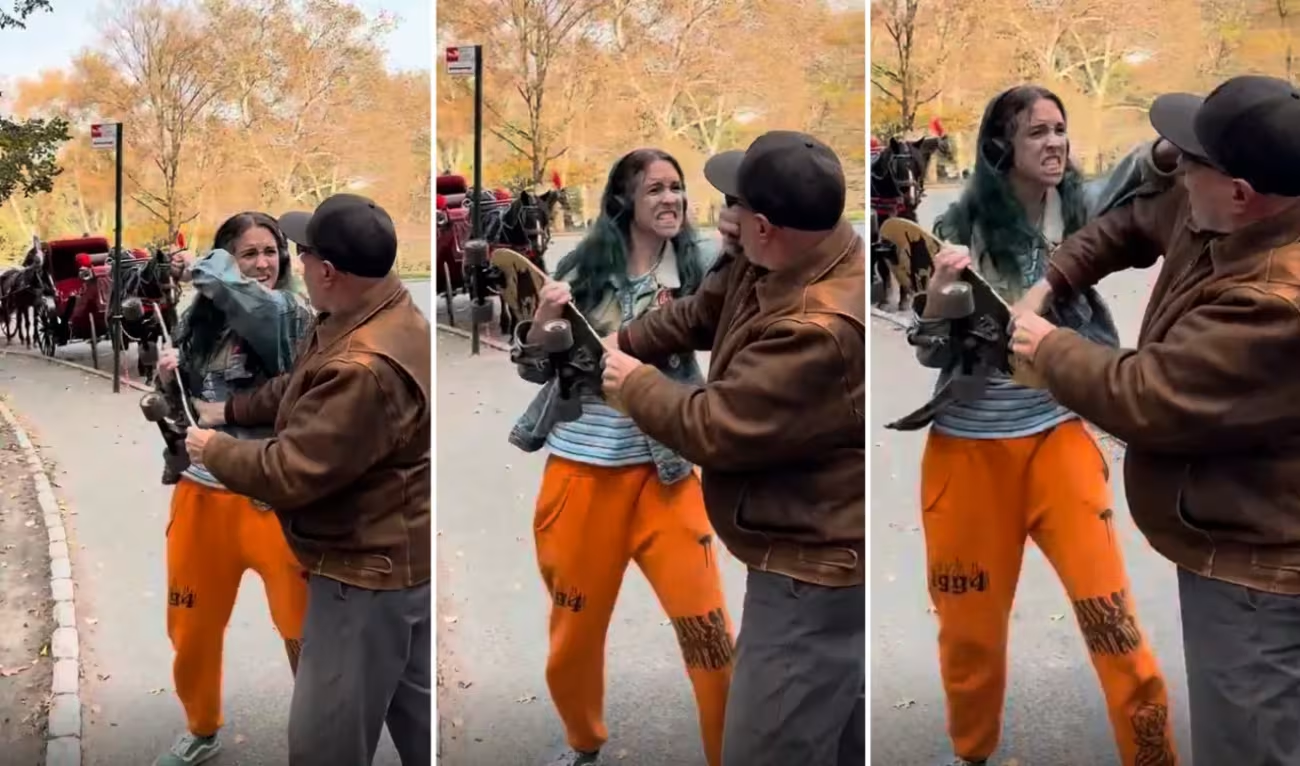
Abigail Holbrook, a 27-year-old woman from Philadelphia, Pennsylvania, was arrested on November 10, 2026, after allegedly assaulting two horse-drawn carriage drivers during a confrontation in New York City's Central Park. According to the New York Police Department (NYPD), Holbrook struck one 45-year-old driver in the face and shoulder with a skateboard before punching a second driver in the face. Both men suffered minor injuries and declined medical treatment. The confrontation was recorded by one of the carriage drivers and circulated through Transport Workers Union Local 100. Holbrook was charged with two counts of assault. The incident occurred amid growing tensions surrounding New York City's horse-drawn carriage industry, following the City Council's October approval of Romanch's Law, legislation designed to phase out the industry by June 2028.
Abigail Holbrook Quick Facts
| Full Name | Abigail Holbrook |
|---|---|
| Age | 27 |
| Hometown | Philadelphia, Pennsylvania |
| Other Location Connection | Ambler, Montgomery County, Pennsylvania |
| Incident Date | November 10, 2026 |
| Incident Location | Central Park, Manhattan, New York City |
| Alleged Weapon | Skateboard |
| Number of Alleged Victims | Two |
| Victims' Ages | Both 45 |
| Arresting Agency | New York Police Department |
| Charges | Two counts of assault |
| Reported Prior Arrest History | None in New York or Pennsylvania |
Who Is Abigail Holbrook?
Abigail Holbrook is a 27-year-old woman from Philadelphia who became the subject of a police investigation after a physical confrontation with two horse-drawn carriage drivers in Central Park.
Daily Voice reported that she also has connections to Ambler, a community in Montgomery County, Pennsylvania.
Her name became widely reported after cellphone footage of the November 10 confrontation circulated online.
In the video, Holbrook can be heard accusing carriage drivers of abusing horses and arguing that the animals should not be used for transportation in New York City.
The argument allegedly escalated into physical violence, with police accusing her of striking one driver with a skateboard and punching another.
According to the NYPD, Holbrook had no previous arrest history in either New York or Pennsylvania.
What Happened During the Central Park Attack?
The confrontation occurred near West Drive and West 59th Street in Central Park on Tuesday, November 10, 2026.
Police said officers responded to a 911 call at approximately 11:08 a.m. after receiving reports of a dispute involving two 45-year-old men and a 27-year-old woman.
According to the NYPD, Holbrook struck one of the carriage drivers in the face and shoulder using a skateboard.
She allegedly punched the second driver in the face during the same confrontation.
Both men sustained minor injuries but declined medical treatment at the scene.
The confrontation was recorded by one of the drivers, providing video evidence of at least part of the incident.
The footage was subsequently shared through Transport Workers Union Local 100, which represents New York City's carriage drivers.
What Does the Viral Video Show?
The cellphone recording shows Holbrook confronting carriage drivers and accusing them of mistreating horses.
She can be heard criticizing the use of horses for carriage rides in New York City and describing the drivers as animal abusers.
At one point, she says:
"You're animal abusers."
The footage shows the argument escalating as Holbrook approaches one of the drivers with her skateboard.
According to the police account, she struck the man in the face and shoulder before punching another driver.
One of the drivers can be seen taking hold of the skateboard during the confrontation.
The recording was distributed by TWU Local 100 as part of its response to the incident.
Although the video provides important context, it does not necessarily capture every moment of the confrontation. The complete sequence of events remains subject to police investigation and court proceedings.
Why Did Abigail Holbrook Confront the Horse Carriage Drivers?
The confrontation reportedly began with an argument about animal welfare.
Holbrook accused the drivers of abusing their horses and questioned the practice of operating horse-drawn carriages in a crowded urban environment.
Animal welfare organizations have raised similar concerns for years, arguing that horses face unnecessary risks from traffic, noise, pollution and extreme weather conditions.
However, the carriage industry disputes those allegations and maintains that its horses receive proper care and veterinary attention.
The argument between Holbrook and the drivers took place against this broader political and social dispute.
Regardless of the opposing positions on animal welfare, the alleged physical assault is a separate criminal matter.
How Was Abigail Holbrook Arrested?
Following the confrontation, one of the carriage drivers contacted emergency services.
NYPD officers responded to the area near West Drive and West 59th Street at approximately 11:08 a.m.
Police investigated the incident and identified Holbrook as the woman involved in the altercation.
She was subsequently arrested and charged with two counts of assault.
The NYPD confirmed the arrest to ABC7 New York and Daily Voice on November 11.
The department also confirmed that both alleged victims were 45 years old and had declined medical treatment for their minor injuries.
What Charges Does Abigail Holbrook Face?
Holbrook faces two counts of assault arising from the alleged attacks on the two carriage drivers.
The allegations involve two separate actions during the confrontation:
- Striking one driver in the face and shoulder with a skateboard.
- Punching a second driver in the face.
Some media reports described the allegations as felony assault charges, but the initial NYPD confirmation identified the charges as two counts of assault without providing a complete breakdown of the statutory classifications.
The exact charges and their legal classifications should therefore be confirmed through the criminal court docket.
Her arraignment was pending in Manhattan Criminal Court when the initial reports were published.
Holbrook is presumed innocent unless proven guilty in court.
What Did the Horse Carriage Drivers Say?
Representatives of Transport Workers Union Local 100 condemned the alleged attack and called for greater police protection for carriage drivers.
Alexander Kemp, the union's administrative vice president, described the incident as unacceptable.
He argued that workers should be able to perform their jobs without facing harassment or physical violence.
Christina Hansen, a TWU shop steward who said she witnessed the confrontation and contacted police, also criticized the incident.
Hansen argued that hostility directed toward carriage drivers had created an increasingly difficult working environment.
The union also criticized public statements by animal rights activists that it believes unfairly portray all carriage operators as animal abusers.
These statements represent the union's position in the wider debate over the future of the industry.
Why Is New York City Planning to Ban Horse-Drawn Carriages?
The confrontation occurred less than a month after the New York City Council voted to approve legislation known as Romanch's Law.
On October 22, 2026, the Council approved the measure by a vote of 40 to 7.
The legislation establishes a timetable for ending licensed horse-drawn carriage operations in New York City by June 1, 2028.
The debate over the industry has continued for nearly two decades, with animal welfare organizations arguing that horse-drawn carriage operations are incompatible with modern urban traffic conditions.
Supporters of the legislation have also cited safety concerns involving horses, pedestrians, drivers and tourists.
Carriage operators and their representatives oppose the ban, arguing that the industry provides livelihoods for workers and that properly managed horses can work safely.
What Is Romanch's Law?
Romanch's Law is legislation approved by the New York City Council on October 22, 2026, to phase out the city's horse-drawn carriage industry.
The measure was named after Romanch Mahajan, an 18-year-old tourist from India who died following a carriage accident in Central Park during the summer of 2026.
According to reports, Mahajan was thrown from a carriage after its horse became startled and bolted during a sightseeing trip.
His death intensified demands for changes to the industry and contributed to renewed political momentum behind the legislation.
The Council's vote followed years of debate involving animal welfare advocates, carriage operators, labor representatives and city officials.
When Will New York City's Horse Carriage Ban Take Effect?
Under Romanch's Law, licensed horse-drawn carriage operations are scheduled to end by June 1, 2028.
The legislation also establishes requirements for a transition plan covering workers, business owners and the horses currently used in the industry.
| Deadline | Requirement |
|---|---|
| April 1, 2027 | Deadline for the city administration to develop a workforce transition plan. |
| June 1, 2027 | Horse owners must certify compliance with restrictions against transferring horses for slaughter or other prohibited purposes. |
| May 31, 2028 | Existing carriage licenses are scheduled to expire. |
| June 1, 2028 | Scheduled end of licensed horse-drawn carriage operations. |
The legislation also requires the city to explore employment referrals, career counseling, hiring fairs and educational opportunities for affected workers.
It provides for efforts to identify humane placement options for retired carriage horses.
However, the implementation process and legal status of the legislation remain important considerations as the city moves toward the scheduled phase-out.
Why Are Animal Rights Activists Supporting the Ban?
Animal welfare organizations have campaigned against horse-drawn carriage operations in New York City for many years.
Groups including PETA and NYCLASS argue that the city's traffic, noise, pollution and changing weather conditions create unnecessary risks for working horses.
They have also raised concerns about accidents involving horses, pedestrians and vehicles.
Supporters of the ban believe that ending the industry would reduce animal welfare risks and prevent further carriage-related accidents.
The death of Romanch Mahajan added urgency to these arguments.
However, advocacy for a ban does not establish that every carriage operator mistreats animals. Individual allegations of abuse require evidence and appropriate investigation.
Why Are Carriage Drivers Opposing the Ban?
Carriage drivers and industry representatives argue that the proposed ban threatens their livelihoods and family businesses.
Some operators have invested substantial amounts of money in horses, equipment, licenses and stables.
Transport Workers Union Local 100 has called for meaningful financial assistance and employment protections for affected workers.
The union has also indicated that it intends to challenge the legislation in federal court.
Its representatives argue that the city must properly consider the economic consequences of eliminating an established industry.
Supporters of the ban, meanwhile, emphasize animal welfare and public safety as reasons for proceeding with the phase-out.
The competing positions have made the issue a major point of disagreement among lawmakers, workers and advocacy groups.
Abigail Holbrook Arrest and Romanch's Law Timeline
| Date | Development |
|---|---|
| Summer 2026 | Romanch Mahajan dies following a Central Park carriage accident. |
| October 22, 2026 | New York City Council approves Romanch's Law by a 40-7 vote. |
| November 10, 2026 | Abigail Holbrook allegedly attacks two carriage drivers near West Drive and West 59th Street. |
| November 10, 2026 | NYPD responds to the incident and arrests Holbrook. |
| November 11, 2026 | Police confirm the arrest and two assault charges to local media. |
| April 1, 2027 | Deadline for the city's workforce transition plan. |
| June 1, 2028 | Scheduled end of licensed horse-drawn carriage operations. |
What Happens Next in the Abigail Holbrook Case?
The criminal proceedings will determine whether prosecutors can establish that Holbrook assaulted the two carriage drivers.
Video footage, witness accounts, police reports and medical information may become relevant during the proceedings.
The case is separate from the legislative process concerning Romanch's Law.
Meanwhile, New York City officials must continue addressing the transition requirements associated with the planned end of the carriage industry.
The incident has also renewed discussions about the safety of workers, protesters and members of the public during confrontations involving animal welfare activism.
Political disagreements over the industry do not justify physical violence, and criminal allegations must be assessed independently of the broader policy debate.
Conclusion
Abigail Holbrook, 27, was arrested after allegedly attacking two horse-drawn carriage drivers during a confrontation in Central Park on November 10, 2026.
According to the NYPD, she struck one driver in the face and shoulder with a skateboard and punched a second driver in the face. Both men suffered minor injuries and declined medical treatment.
The incident occurred amid an ongoing dispute over New York City's horse-drawn carriage industry, following the City Council's approval of Romanch's Law on October 22.
The legislation provides for a phase-out of licensed carriage operations by June 2028, with a transition plan intended to address the livelihoods of workers and the welfare of retired horses.
Although Holbrook's arrest has intensified public discussion about the conflict between animal welfare activists and carriage operators, the assault case and the legislative debate remain separate matters.
Holbrook has been charged with two counts of assault and remains presumed innocent unless proven guilty in court.
- Log in to post comments